API Index
This page contains an index of the SISCI API. For a gentle introduction, refer to Overview.
-
struct dis_dma_vec_t
- #include <sisci_types.h>
DMA queue vector interface for function SCIStartDmaTransferVec().
-
struct sci_address_t
-
struct sci_dma_capabilities_t
-
struct sci_query_adapter_t
-
struct sci_query_dma_t
-
struct sci_query_local_segment_t
Public Members
-
sci_local_segment_t segment
-
unsigned int subcommand
-
sci_ioaddr_t ioaddr
-
union sci_query_local_segment_t data
-
sci_local_segment_t segment
-
struct sci_query_map_t
-
struct sci_query_remote_segment_t
Public Members
-
sci_remote_segment_t segment
-
unsigned int subcommand
-
sci_ioaddr_t ioaddr
-
union sci_query_remote_segment_t data
-
sci_remote_segment_t segment
-
struct sci_query_string_t
-
struct sci_query_system_t
-
struct sci_smartio_device_info_t
- #include <sisci_types.h>
SmartIO device information.
Public Members
-
unsigned long long fdid
-
unsigned short pci_device_id
-
unsigned short pci_vendor_id
-
unsigned int pci_class
-
unsigned short pci_subsystem_device_id
-
unsigned short pci_subsystem_vendor_id
-
unsigned long long pci_serial_number
-
unsigned short remote_bdf
-
unsigned short local_bdf
-
unsigned int adapter
-
unsigned int nodeid
-
int physical_slot
-
char user_name[64]
-
char uuid[37]
-
unsigned long long fdid
-
struct sci_smartio_query_device_t
- file sisci_api.h
- #include <stddef.h>#include “sisci_types.h”#include “sisci_error.h”#include “sisci_api_macros.h”
Low-level SISCI software functional specification.
The SISCI API implementation from Dolphin is available with Dolphins IX, PX, MX and Intel NTB (INX) enabled PCI Express products and for various 3rd party OEM hardware solutions licensing the software.
Remark
Some extensions, for example Reflective Memory is only available for some hardware configurations. Please consult your hardware vendor and software release notes for details.
Please read the manual carefully and consult the available SISCI example code found in the software distribution / SISCI Devel package as well as the SISCI Users guide available for download from http://www.dolphinics.com
Typedefs
-
typedef char *sci_semaphoreId_t
Functions
-
SISCI_API_EXPORT void SCIInitialize(unsigned int flags, sci_error_t *error)
Initializes the SISCI library.
SCIInitialize() must be called before SCIOpen().
Error codes:
SCI_ERR_OK
Successful completion.
No specific error codes for this function.
- Parameters:
flags – see below
error – error information
-
SISCI_API_EXPORT void SCITerminate(void)
Terminates and releases resources associated with the SISCI library.
SCITerminate() must be called after SCIClose().
Error codes:
SCI_ERR_OK
Successful completion.
No specific error codes for this function.
-
SISCI_API_EXPORT void SCIOpen(sci_desc_t *sd, unsigned int flags, sci_error_t *error)
Opens an SISCI virtual device.
SCIOpen() opens an SISCI virtual device, that is a channel to the driver. It creates and initializes a new descriptor for an SISCI virtual device, to be used in subsequent calls to API functions. A single virtual device can be used for all API functions, but it can only handle a limited number of each resource type (see below).
Error codes:
SCI_ERR_OK
Successful completion.
No specific error codes for this function.
Note
The virtual device handle can currently handle 32 instances of each SISCI resource type. I.e., one virtual device can manage 32 local segments, 32 remote segments, 32 sequences, 32 interrupts, 32 interrupts with data etc. If you want to establish, e.g., 64 remote segment connections, you need to open two or more virtual devices.
- Parameters:
sd – handle to the new SISCI virtual device descriptor
flags – not used
error – error information
-
SISCI_API_EXPORT void SCIClose(sci_desc_t sd, unsigned int flags, sci_error_t *error)
Closes an open SISCI virtual device.
SCIClose() closes an open SISCI virtual device, destroying its descriptor. After this call the handle to the descriptor becomes invalid and should not be used. SCIClose does not deallocate possible resources that are still in use, rather it fails if some of them exist.
Error codes:
SCI_ERR_OK
Successful completion
SCI_ERR_BUSY
Some resources depending on this virtual device are still in use
- Parameters:
sd – handle to an open SISCI virtual device descriptor
flags – not used
error – error information
-
SISCI_API_EXPORT void SCIConnectSegment(sci_desc_t sd, sci_remote_segment_t *segment, unsigned int nodeId, unsigned int segmentId, unsigned int localAdapterNo, sci_cb_remote_segment_t callback, void *callbackArg, unsigned int timeout, unsigned int flags, sci_error_t *error)
Connects an application to a memory segment.
SCIConnectSegment() connects an application to a memory segment made available on a local or remote node (see SCISetSegmentAvailable()) and creates and initializes a descriptor for the connected segment. A call to this function enters the state diagram for a remote segment shown in Figure State diagram for remote segments. If a timeout different from SCI_INFINITE_TIMEOUT is passed to the function, the attempt to connect will stop after the specified number of milliseconds. Implementation notice: Dolphin has not implemented support for setting a timeout different from SCI_INFINITE_TIMEOUT.
The connection operation is by default synchronous: the function returns only when the operation has completed; a failure exits the state diagram and gives back a handle that is not valid and that should not be used.
If the flag SCI_FLAG_ASYNCHRONOUS_CONNECT is specified the connection is instead asynchronous: the function returns immediately with a valid handle. In case of failure, the descriptor has to be explicitly destroyed calling SCIDisconnectSegment(). Implementation notice: The SCI_FLAG_ASYNCHRONOUS_CONNECT is not implemented by Dolphin.
A callback function can be specified to be invoked when an event concerning the segment happens; the intention to use the callback has to be explicitly declared with the flag SCI_FLAG_USE_CALLBACK. Alternatively, interesting events can be caught using the function SCIWaitForRemoteSegmentEvent.
Once a memory segment has been connected, it can either be mapped in the address space of the program, see SCIMapRemoteSegment() or be used directly for DMA transfers, (see SCIEnqueueDMATransfer()). A successful connection also generates an SCI_CB_CONNECT event directed to the application that created the segment (see SCICreateSegment() and sci_cb_local_segment_t).
Flags:
SCI_FLAG_USE_CALLBACK
The specified callback is active
SCI_FLAG_ASYNCHRONOUS_CONNECT
The connection is asynchronous. Not implemented.
SCI_FLAG_BROADCAST
This flag must be set to enable the use of multicast and use the reflected memory mechanism. This function connects to all available remote broadcast segments with the same segmentId. The remote segments must be created with the function
SCICreateSegment() and with the SCI_FLAG_BROADCAST flag specified. SCICreateSegment(..,SCI_FLAG_BROADCAST). This flag is only available for configurations supporting multicast. If this flag is used, the nodeId parameter should be set to DIS_BROADCAST_NODEID_GROUP_ALL.
Error codes:
SCI_ERR_OK
Successful completion
SCI_ERR_NO_SUCH_SEGMENT
The remote segment to connect could not be found
SCI_ERR_CONNECTION_REFUSED
The connection attempt has been refused by the remote node
SCI_ERR_TIMEOUT
The function timed out
SCI_ERR_NO_LINK_ACCESS
It was not possible to communicate via the local adapter
SCI_ERR_NO_REMOTE_LINK_ACCESS
Not possible to communicate via a remote switch port
SCI_ERR_SYSTEM
The callback thread could not be created
- Parameters:
sd – handle to an open SISCI virtual device descriptor
segment – handle to the new connected segment descriptor
nodeId – identifier of the node where the segment is allocated
segmentId – identifier of the segment to connect
localAdapterNo – number of the local adapter used for the connection
callback – function called when an asynchronous event affecting the segment occurs
callbackArg – user-defined parameter passed to the callback function
timeout – time in milliseconds to wait for the connection to complete. Currently not implemented, parameter should always be set to SCI_INFINITE_TIMEOUT
flags – see below
error – error information
-
SISCI_API_EXPORT void SCIDisconnectSegment(sci_remote_segment_t segment, unsigned int flags, sci_error_t *error)
SCIDisconnectSegment() disconnects from the give mapped shared memory segment.
SCIDisconnectSegment() disconnects from a remote segment connected by calling SCIConnectSegment() and deallocates the corresponding descriptor. After this call the handle to the descriptor becomes invalid and should not be used.
If the segment was connected using SCIConnectSegment() the execution of SCIDisconnectSegment also generates an SCI_CB_DISCONNECT event directed to the application that created the segment (see SCICreateSegment() and sci_cb_local_segment_t).
Error codes:
SCI_ERR_OK
Successful completion
SCI_ERR_BUSY
The segment is currently mapped or in use
- Parameters:
segment – handle to the connected segment descriptor
flags – not used
error – error information
-
SISCI_API_EXPORT size_t SCIGetRemoteSegmentSize(sci_remote_segment_t segment)
SCIGetRemoteSegmentSize() returns the size in bytes of a remote segment after it has been connected with SCIConnectSegment().
- Parameters:
segment – handle to the connected segment descriptor
- Returns:
The function returns the size in bytes of the remote segment.
-
SISCI_API_EXPORT unsigned int SCIGetRemoteSegmentId(sci_remote_segment_t segment)
Retrieve the segment identifier of a remote segment connected with SCIConnectSegment().
- Parameters:
segment – handle to the connected segment descriptor
- Returns:
The function returns the segment identifier.
-
SISCI_API_EXPORT unsigned int SCIGetRemoteSegmentNodeId(sci_remote_segment_t segment)
Retrieve the node identifier of the remote or local node where the connected segment is hosted.
- Parameters:
segment – handle to the connected segment descriptor
- Returns:
The function returns the node identifier of the remote segment.
-
SISCI_API_EXPORT volatile void *SCIGetMapPointer(sci_map_t map)
Retrieve a memory pointer of a previously mapped segment.
This is the same pointer as returned by the original call to SCIMapLocalSegment() or SCIMapRemoteSegment().
Introduced in DIS release 5.16.0
- Parameters:
map – handle to the mapped segment descriptor
- Returns:
The function returns a pointer to the beginning of the mapped area.
-
SISCI_API_EXPORT sci_ioaddr_t SCIGetMapPhysAddr(sci_map_t map)
Retrieve the local physical address of the mapped segment.
If the segment is local, this is the physical address of the segment. If the segment is remote, this address is the physical address that maps over the local adapter.
Introduced in DIS release 5.16.0
- Parameters:
map – handle to the mapped segment descriptor
- Returns:
Local physical address used to reach the segment, or 0 on error.
-
SISCI_API_EXPORT sci_segment_cb_reason_t SCIWaitForRemoteSegmentEvent(sci_remote_segment_t segment, sci_error_t *status, unsigned int timeout, unsigned int flags, sci_error_t *error)
SCIWaitForRemoteSegmentEvent() blocks a program until an event concerning the remote segment has arrived.
If a timeout different from SCI_INFINITE_TIMEOUT is specified the function gives up when the timeout expires. SCIWaitForRemoteSegmentEvent() cannot be used if a callback associated with the remote segment is active (see SCIConnectSegment()).
Error codes:
SCI_ERR_OK
Successful completion.
SCI_ERR_TIMEOUT
The function timed out after specified timeout value
SCI_ERR_ILLEGAL_OPERATION
Illegal operation.
SCI_ERR_CANCELLED
The segment has been disconnected. The handle is invalid when this error is returned
- Parameters:
segment – handle to the connected segment descriptor
status – status information
timeout – time in milliseconds to wait before giving up
flags – not used
error – error information
- Returns:
If successful, the function returns the reason that generated the received event.
-
SISCI_API_EXPORT volatile void *SCIMapRemoteSegment(sci_remote_segment_t segment, sci_map_t *map, size_t offset, size_t size, void *addr, unsigned int flags, sci_error_t *error)
SCIMapRemoteSegment() maps an area of a remote segment connected with SCIConnectSegment() into the addressable space of the program and returns a pointer to the beginning of the mapped area.
The function also creates and initializes a descriptor for the mapped segment.
If a virtual address is suggested, together with the flag SCI_FLAG_FIXED_MAP_ADDR, the function tries first to map the segment at that address. If the flag SCI_FLAG_READONLY_MAP is specified, the remote segment is mapped read-only.
Flags:
SCI_FLAG_SHARED_MAP
The low level physical map may be shared by other applications.
SCI_FLAG_FIXED_MAP_ADDR
Map at the suggested virtual address
SCI_FLAG_READONLY_MAP
The segment is mapped in read-only mode
SCI_FLAG_IO_MAP_IOSPACE
Mapping using non-prefetch space (iospace) No prefetching, or speculative hold enabled.
Error codes:
SCI_ERR_OK
Successful completion.
SCI_ERR_NOT_CONNECTED
The links between local and remote node are not active.
SCI_ERR_OUT_OF_RANGE
The sum of the offset and size is larger than the segment size.
SCI_ERR_SIZE_ALIGNMENT
Size is not correctly aligned as required by the implementation.
SCI_ERR_OFFSET_ALIGNMENT
Offset is not correctly aligned as required by the implementation.
SCI_ERR_FLAG_NOT_IMPLEMENTED
Not implemented.
-
SISCI_API_EXPORT void *SCIMapLocalSegment(sci_local_segment_t segment, sci_map_t *map, size_t offset, size_t size, void *addr, unsigned int flags, sci_error_t *error)
SCIMapLocalSegment() maps an area of a memory segment created with SCICreateSegment() into the addressable space of the program and returns a pointer to the beginning of the mapped area.
The function also creates and initializes a descriptor for the mapped segment.
If a virtual address is suggested, together with the flag SCI_FLAG_FIXED_MAP_ADDR, the function tries first to map the segment at that address. If the flag SCI_FLAG_READONLY_MAP is specified, the local segment is mapped in read-only more.
Flags:
SCI_FLAG_FIXED_MAP_ADDR
The function should try first to map at the suggested virtual address
SCI_FLAG_READONLY_MAP
The segment is mapped in read-only mode
Error codes:
SCI_ERR_OK
Successful completion.
SCI_ERR_OUT_OF_RANGE
The sum of the offset and size is larger than the segment size.
SCI_ERR_SIZE_ALIGNMENT
Size is not correctly aligned as required by the implementation.
SCI_ERR_OFFSET_ALIGNMENT
Offset is not correctly aligned as required by the implementation.
- Parameters:
segment – handle to the descriptor of the local segment to be mapped
map – handle to the new mapped segment descriptor
offset – offset inside the local segment where the mapping should start
size – size of the area of the local segment to be mapped, starting from offset
addr – suggested virtual address where the segment should be mapped
flags – see below
error – error information
- Returns:
If successful, the function returns a pointer to the beginning of the mapped area. In case of error it returns 0.
-
SISCI_API_EXPORT void SCIUnmapSegment(sci_map_t map, unsigned int flags, sci_error_t *error)
SCIUnmapSegment() unmaps from the programs address space a segment that was mapped either with SCIMapLocalSegment() or with SCIMapRemoteSegment().
It also destroys the corresponding descriptor, therefore after this call the handle to the descriptor becomes invalid and should not be used.
Error codes:
SCI_ERR_OK
Successful completion.
SCI_ERR_BUSY
The map is currently in use.
- Parameters:
map – handle to the mapped segment descriptor
flags – not used
error – error information
-
SISCI_API_EXPORT void SCICreateSegment(sci_desc_t sd, sci_local_segment_t *segment, unsigned int segmentId, size_t size, sci_cb_local_segment_t callback, void *callbackArg, unsigned int flags, sci_error_t *error)
SCICreateSegment() allocates a memory segment and creates and initializes a descriptor for a local segment.
A host-wide unique identifier is associated to the new segment. This function causes a local segment to enter its state diagram, shown in Figure Local segment state diagram.
A callback function can be specified to be invoked when an event concerning the segment happens (see sci_segment_cb_reason_t); the intention to use the callback has to be explicitly declared with the flag SCI_FLAG_USE_CALLBACK. Alternatively, interesting events can be caught using the function SCIWaitForLocalSegmentEvent().
If the flag SCI_FLAG_EMPTY is specified, no memory is allocated for the segment and only the descriptor is initialized. Using the flag SCI_FLAG_PRIVATE declares that the segment will never be made available for external connections (see SCISetSegmentAvailable()); in this case the specified segment identifier is meaningless, avoiding the internal check for its uniqueness. These two flags are useful to transform a user-allocated piece of memory (e.g. via malloc) into a mapped segment. An empty and private segment is first created and then associated to the user-allocated memory (see SCIRegisterSegmentMemory()); the segment can then be transformed in a mapped segment (see SCIMapLocalSegment()) and possibly prepared for a DMA transfer (see SCIPrepareSegment()).
SCICreateSegment() will fail with the error code SCI_ERR_NOSPC if the driver / system did not manage to allocate the required amount of memory. Please consult the eXpressWare installation guide, section “Managing PCIe and eXpressWare Resources” for additional information on how to tune resources.
Flags:
SCI_FLAG_USE_CALLBACK
The callback function will be invoked for events on this segment.
SCI_FLAG_EMPTY
No memory will be allocated for the segment.
SCI_FLAG_PRIVATE
The segment will be private meaning it will never be any connections to it.
SCI_FLAG_DMA_GLOBAL
Setting this flag creates a segment that can only be used for global DMA. It cannot be mapped for PIO access or mapped DMA access.
SCI_FLAG_BROADCAST
This flag must be set to enable use of the multicast and the reflected memory mechanism. Creates a segment for multicast/reflected memory capabilities. All segments in a broadcast group must have the same segmentId. This flag is only available for configurations supporting multicast.
SCI_FLAG_ALLOW_UNICAST
This flag may be used in conjunction with SCI_FLAG_BROADCAST in order to allow regular unicast connections to this local segment. For Dolphin PCI Express PX this flag can only be used with group 0, no other regular multicast segment can be used simultaneously. Segments allocated with this flag are allocated from the general segment memory pool and so compete with regular segments.
SCI_FLAG_AUTO_ID
Setting this flag specifies that the implementation should automatically assign an available segment identifier in the range [segmentId, segmentId+128]. After the segment has been created, the assigned segment identifier can be retrieved using
SCIGetLocalSegmentId().
Error codes:
SCI_ERR_OK
Successful completion.
SCI_ERR_NOSPC
Not able to allocate local memory resources. More details above.
SCI_ERR_SEGMENTID_USED
The segment with this segmentId is already used.
SCI_ERR_SIZE_ALIGNMENT
Size is not correctly aligned as required by the implementation.
SCI_ERR_SYSTEM
The callback thread could not be created.
- Parameters:
sd – handle to an open SISCI virtual device descriptor
segment – handle to the new local segment descriptor
segmentId – segment identifier
size – segment size; if SCI_FLAG_EMPTY is specified, size means the maximum size of the memory area that can be associated with this local segment
callback – callback function called when an asynchronous event affecting the local segment occurs
callbackArg – user-defined argument passed to the callback function
flags – see below
error – error information
-
SISCI_API_EXPORT sci_segment_cb_reason_t SCIWaitForLocalSegmentEvent(sci_local_segment_t segment, unsigned int *sourcenodeId, unsigned int *localAdapterNo, unsigned int timeout, unsigned int flags, sci_error_t *error)
SCIWaitForLocalSegmentEvent() blocks a program until an event concerning the local segment has arrived.
If a timeout different from SCI_INFINITE_TIMEOUT is specified the function gives up when the timeout expires. SCIWaitForLocalSegmentEvent() cannot be used if a callback associated with the local segment is active (see SCICreateSegment()).
Error codes:
SCI_ERR_OK
Successful completion.
SCI_ERR_TIMEOUT
The function timed out after specified timeout value.
SCI_ERR_CANCELLED
The wait operation has been cancelled due to a
SCIRemoveSegment() on the same handle. The handle is invalid when this error is returned.
- Parameters:
segment – handle to local segment descriptor
sourcenodeId – identifier of the node that have generated the event
localAdapterNo – number of the local adapter that receive the event
timeout – time in milliseconds to wait before giving up
flags – not used
error – error information
- Returns:
If successful, the function returns the reason corresponding to the received event.
-
SISCI_API_EXPORT void SCIPrepareSegment(sci_local_segment_t segment, unsigned int localAdapterNo, unsigned int flags, sci_error_t *error)
SCIPrepareSegment() enables a local segment to be accessible from the specified network adapter.
Flags:
SCI_FLAG_DMA_SOURCE_ONLY
The segment will be used as a source segment for DMA operations. On some system types this will enable the SISCI driver to use performance improving features.
Error codes:
SCI_ERR_OK
Successful completion.
No specific error codes for this function.
- Parameters:
segment – handle to the local segment descriptor
localAdapterNo – Adapter number for which the segment is made available
flags – see below
error – error information
-
SISCI_API_EXPORT void SCIRemoveSegment(sci_local_segment_t segment, unsigned int flags, sci_error_t *error)
SCIRemoveSegment() frees the resources used by a local segment.
The physical memory is deallocated only if it was allocated when the segment was created with SCICreateSegment(). The function also destroys the descriptor associated with the local segment; after this call the handle to the descriptor becomes invalid and should not be used. SCIRemoveSegment() fails if other resources, either locally or remotely, depend on it. Before calling this function, the program should consider the use of SCISetSegmentUnavailable() with the flags NOTIFY or FORCE_DISCONNECT.
Flags:
SCI_FLAG_FORCE_REMOVE
Force the removal of the segment even if there still exists active connections.
Error codes:
SCI_ERR_OK
Successful completion.
SCI_ERR_BUSY
Unable to remove the segment. The segment is currently in use.
Warning
The SCI_FLAG_FORCE_REMOVE is NOT intended for general use. Use with caution and preferably only after consulting with Dolphin support. Incorrect use may cause uncontrolled remote access to unintended memory and may have severe impact on system security and stability. If SCI_FLAG_FORCE_REMOVE is used on segments with attached physical memory, it’s the responsibility of the user to assure proper management of that memory and to assure that all remote connections is closed prior to (possibly) releasing that memory.
- Parameters:
segment – handle to local segment descriptor
flags – see below
error – error information
-
SISCI_API_EXPORT size_t SCIGetLocalSegmentSize(sci_local_segment_t segment)
SCIGetLocalSegmentSize() returns the size in bytes of a local segment after it has been created with SCICreateSegment().
- Parameters:
segment – handle to the local segment descriptor
- Returns:
The function returns the size in bytes of the local segment.
-
SISCI_API_EXPORT unsigned int SCIGetLocalSegmentId(sci_local_segment_t segment)
Retrieve the segment identifier of a local segment created with SCICreateSegment().
- Parameters:
segment – handle to the local segment descriptor
- Returns:
The function returns the segment identifier
-
SISCI_API_EXPORT void SCISetSegmentAvailable(sci_local_segment_t segment, unsigned int localAdapterNo, unsigned int flags, sci_error_t *error)
SCISetSegmentAvailable() makes a local segment visible to remote nodes, that can then connect to it.
According to the state diagram shown in Figure 2.2 a local segment can be made available only after it has been prepared (see SCIPrepareSegment()).
Error codes:
SCI_ERR_OK
Successful completion.
SCI_ERR_SEGMENT_NOT_PREPARED
The segment has not been prepared for access from this adapter.
SCI_ERR_ILLEGAL_OPERATION
The segment is created with the SCI_FLAG_PRIVATE flag specified and therefore has no segmentId.
- Parameters:
segment – handle to local segment descriptor
localAdapterNo – number of the local adapter where the local segment is made available for connections
flags – not used.
error – error information
SCISetSegmentUnavailable() hides an available segment to remote nodes; no new connections will be accepted on that segment.
If the flag SCI_FLAG_NOTIFY is specified, the operation is notified to the remote nodes connected to the local segment. The notification should be interpreted as an invitation to disconnect. If the flag SCI_FLAG_FORCE_DISCONNECT is specified, the remote nodes are forced to disconnect. These two flags can be used to implement a smooth removal of a local segment (see SCIRemoveSegment()).
Flags:
SCI_FLAG_FORCE_DISCONNECT
The connected nodes are forced to disconnect
SCI_FLAG_NOTIFY
The connected nodes receive a notification of the operation
Error codes:
SCI_ERR_OK
Successful completion.
SCI_ERR_ILLEGAL_OPERATION
The operation is illegal in the current state of the segment
- Parameters:
segment – handle to the local segment descriptor
localAdapterNo – number of the local adapter where the local segment was made available
flags – see below
error – error information
-
SISCI_API_EXPORT void SCICreateMapSequence(sci_map_t map, sci_sequence_t *sequence, unsigned int flags, sci_error_t *error)
SCICreateMapSequence() creates and initializes a new sequence descriptor that can be used to check for errors occurring in a transfer of data from or to a mapped remote segment.
Error codes:
SCI_ERR_OK
Successful completion.
SCI_ERR_ILLEGAL_PARAMETER
Invalid map descriptor. (Map has to be of a remote segment)
SCI_ERR_NOSPC
Could not create map sequence.
- Parameters:
map – handle to a valid map descriptor of a remote segment.
sequence – handle to the new sequence descriptor
flags – not used
error – error information
-
SISCI_API_EXPORT void SCIRemoveSequence(sci_sequence_t sequence, unsigned int flags, sci_error_t *error)
SCIRemoveSequence() destroys a sequence descriptor.
After this call the handle to the descriptor becomes invalid and should not be used.
Error codes:
SCI_ERR_OK
Successful completion.
No specific errors for this function.
- Parameters:
sequence – handle to the sequence descriptor
flags – not used
error – error information
-
SISCI_API_EXPORT sci_sequence_status_t SCIStartSequence(sci_sequence_t sequence, unsigned int flags, sci_error_t *error)
SCIStartSequence() performs the preliminary check of the error flags on the network adapter before starting a sequence of read and write operations on the concerned mapped segment.
Subsequent checks are done calling SCICheckSequence(), as far as no errors occur, in which case SCIStartSequence() shall be called again until it returns SCI_SEQ_OK. If the return value is SCI_SEQ_PENDING there is a pending error and the program is required to call SCIStartSequence() until it succeeds, before doing other transfer operations on the segment.
Error codes:
SCI_ERR_OK
Successful completion.
No specific errors for this function.
- Parameters:
sequence – handle to the sequence descriptor
flags – not used
error – error information
- Returns:
The function returns the status of the sequence.
-
SISCI_API_EXPORT sci_sequence_status_t SCICheckSequence(sci_sequence_t sequence, unsigned int flags, sci_error_t *error)
SCICheckSequence() checks if any error has occurred in a data transfer controlled by a sequence since the last check.
The previous check can have been done by calling either SCIStartSequence(), that also initiates the sequence, or SCICheckSequence() itself. SCICheckSequence() can be invoked several times in a row without calling SCIStartSequence(), as far as it does not fail, returning SCI_SEQ_OK (i.e. there were no transmission errors in the sequence). If the return value is SCI_SEQ_RETRIABLE the operation can be immediately retried. A return value SCI_SEQ_NOT_RETRIABLE means that there have been a fatal error, probably also notified via callbacks to the corresponding mapped segment; it is not legal to execute other read or write operations on the segment until a call to SCIStartSequence() does not fail. As well, if the return value is SCI_SEQ_PENDING it is not legal to perform read or write operations on the segment until a call to SCIStartSequence() does not fail. The default behaviour of SCICheckSequence() is to flush any write buffers and to wait for all the outstanding write requests to be completed. To prevent this actions the caller has to use specific flags.
Flags:
SCI_FLAG_NO_FLUSH
Do not flush the write buffers
SCI_FLAG_NO_STORE_BARRIER
Do not wait for outstanding write requests
Error codes:
SCI_ERR_OK
Successful completion.
No specific error values for this function.
- Parameters:
sequence – handle to a sequence descriptor
flags – see below
error – error information
- Returns:
The function returns the status of the sequence.
-
SISCI_API_EXPORT void SCIStoreBarrier(sci_sequence_t sequence, unsigned int flags)
SCIStoreBarrier() synchronizes all PIO accesses to a mapped segment.
When the function returns, all IO buffers have been flushed and all outstanding transactions related to the mapped segment have completed.
Error codes:
SCI_ERR_OK
Successful completion.
No specific errors for this function.
- Parameters:
sequence – handle to the mapped segment descriptor
flags – not used
-
SISCI_API_EXPORT int SCIProbeNode(sci_desc_t sd, unsigned int localAdapterNo, unsigned int nodeId, unsigned int flags, sci_error_t *error)
SCIProbeNode() checks if a remote node is reachable.
Error codes:
SCI_ERR_OK
Successful completion, the node is currently reachable through the specified network.
Errors if the function returns 1
SCI_ERR_NO_LINK_ACCESS
It was not possible to reach the node via the specified local adapter.
SCI_ERR_NO_REMOTE_LINK_ACCESS
It was not possible to communicate via a remote switch port.
- Parameters:
sd – handle to an open SISCI virtual device descriptor
localAdapterNo – number of the local adapter used for the check
nodeId – identifier of the remote node
flags – not used
error – error information
- Returns:
The function returns 1 when the remote node can be reached, otherwise it returns 0.
-
SISCI_API_EXPORT unsigned int SCIGetCSRRegister(sci_desc_t sd, unsigned int localAdapterNo, unsigned int SCINodeId, unsigned int CSROffset, unsigned int flags, sci_error_t *error)
-
SISCI_API_EXPORT void SCISetCSRRegister(sci_desc_t sd, unsigned int localAdapterNo, unsigned int SCINodeId, unsigned int CSROffset, unsigned int CSRValue, unsigned int flags, sci_error_t *error)
-
SISCI_API_EXPORT unsigned int SCIGetLocalCSR(sci_desc_t sd, unsigned int localAdapterNo, unsigned int CSROffset, unsigned int flags, sci_error_t *error)
-
SISCI_API_EXPORT void SCISetLocalCSR(sci_desc_t sd, unsigned int localAdapterNo, unsigned int CSROffset, unsigned int CSRValue, unsigned int flags, sci_error_t *error)
-
SISCI_API_EXPORT void SCIAttachPhysicalMemory(sci_ioaddr_t ioaddress, void *address, unsigned int busNo, size_t size, sci_local_segment_t segment, unsigned int flags, sci_error_t *error)
SISCI Privileged function SCIAttachPhysicalMemory() enables usage of physical devices and memory regions where the Physical PCI/PCIe bus address ( and mapped CPU address ) are already known.
The function will register the physical memory as a SISCI segment which can be connected and mapped as a regular SISCI segment.
Requirements: SCICreateSegment() with flag SCI_FLAG_EMPTY must have been called in advance
Flags:
SCI_FLAG_CUDA_BUFFER
Support CUDA managed GPU buffer - NVIDIA
SCI_FLAG_SCIF_BUFFER
Support SCIF buffer - INTEL
Error codes:
SCI_ERR_OK
Successful completion.
No specific errors for this function.
- Parameters:
ioaddress – this is the address on the PCI bus that a PCI bus master has to use to write to the specified memory
address – this is the (mapped) virtual address that the application has to use to access the device. This means that the device has to be mapped in advance by the devices own driver. If the device is not to be accessed by the local CPU, the address pointer should be set to NULL.
busNo – bus number where the device is located. Only required for SPARC system. Should be set to 0 for all other systems
size – size of the memory regions
segment – buffer
flags – see below
error – error information
-
SISCI_API_EXPORT void SCIQuery(unsigned int command, void *data, unsigned int flags, sci_error_t *error)
SCIQuery() provides an interface to request various information from the system, settings and interconnect status.
The information can be vendor dependent, but some requests are specified in the API and must be satisfied: the vendor identifier, the version of the API implemented, and some adapter characteristics. Each request defines its own data structure to be used as input and output to SCIQuery(). The memory management (allocation and deallocation) of the data structures has to be performed by the caller.
A query consist of a major-command and a sub-command.
Commands
Major-commands are listed below:
SCI_Q_ADAPTER
Major command for adapter queries. This query returns adapter specific information depending on the sub-command. The information is returned in the data structure.
SCI_Q_SYSTEM
Major command for system queries. This query returns system specific information depending on the sub-command. The information is returned in the data structure.
SCI_Q_DMA
Major command for DMA queries. This query return DMA specific information depending on the sub-command. The information is returned in the data structure.
SCI_Q_LOCAL_SEGMENT
Major command for local segment queries. This query returns local segment specific information depending on the sub-command. The information is returned in the data structure.
SCI_Q_REMOTE_SEGMENT
Major command for remote segment queries. This query returns remote segment specific information depending on the sub-command. The information is returned in the data structure.
SCI_Q_MAP
Major command for local segment map queries. This query returns local segment map specific information depending on the sub-command. The information is returned in the data structure.
SCI_Q_VENDORID
Major command for vendor id queries. The vendor identifier is returned in a data structure of type sci_query_string.
SCI_Q_API
Major command for vendor id queries. The version of the API implemented is returned in a data structure of type sci_query_string.
SCI_Q_ADAPTER sub-commands:
- SCI_Q_ADAPTER_SERIAL_NUMBER:
  Returns the serial number of the local adapter

- SCI_Q_ADAPTER_CARD_TYPE:
  Returns the card type of local adapter.

- SCI_Q_ADAPTER_NODEID:
  Returns the node id of local adapter.

- SCI_Q_ADAPTER_LINK_OPERATIONAL:
  Returns true if the local link is operational.

- SCI_Q_ADAPTER_CONFIGURED:
  Returns true if the local adapter is configured.

- SCI_Q_ADAPTER_LINK_WIDTH:
  Returns the PCIe link width for the specified link port.

- SCI_Q_ADAPTER_LINK_SPEED:
  Returns the PCIe link speed for the specified link port.

- SCI_Q_ADAPTER_LINK_UPTIME:
  Returns the seconds of link uptime for the specified link port.

- SCI_Q_ADAPTER_LINK_DOWNTIME:
  Returns the seconds of link downtime for the specified link port.

- SCI_Q_ADAPTER_LINK_OPERATIONAL:
  Returns status for the specified link port.

- SCI_Q_ADAPTER_LINK_CABLE_INSERTED:
  Returns if the cable is inserted for the specified link port.

- SCI_Q_ADAPTER_LINK_ENABLED:
  Returns if the link is enabled for the specified link port.

- SCI_Q_ADAPTER_LINK_PARTNER_PORT_NO:
  Returns the partner (remote) link port number for the specified link port.

- SCI_Q_ADAPTER_NUMBER_OF_LINKS:
  Returns the number of adapter link ports that are enabled.

- SCI_Q_ADAPTER_DMA_MTU:
  Returns the max transfer unit (MTU) of the DMA engine of the adapter.
  Flags: SCI_FLAG_DMA_SYSDMA - return the MTU of the system DMA.

- SCI_Q_ADAPTER_MCAST_MAX_GROUPS:
  Returns the number of available multicast groups.

- SCI_Q_ADAPTER_BDF:
  Returns the BDF of the adapter.
SCI_Q_DMA sub-commands:
- SCI_Q_DMA_AVAILABLE:
  Returns whether the DMA mode specified in "flags" is available.

- SCI_Q_DMA_CAPABILITIES:
  Returns the capabilities of the DMA mode specified in "flags".

- Flags: SCI_FLAG_DMA_ADAPTER, SCI_FLAG_DMA_GLOBAL, SCI_FLAG_DMA_SYSDMA
SCI_Q_LOCAL_SEGMENT sub-commands:
- SCI_Q_LOCAL_SEGMENT_IOADDR:
  Returns the base I/O address of the local segment specified in
  the segment member, as seen by one of the local adapters it has
  been prepared on. If the segment has not been prepared on any
  adapters, this query returns 0. See also
  SCIMapLocalSegmentForDevice()

- SCI_Q_LOCAL_SEGMENT_VIRTUAL_KERNEL_ADDR:
  Returns the local virtual kernel address of the local segment.
  This function has been deprecated and will always return 0.

- SCI_Q_LOCAL_SEGMENT_PHYS_ADDR :
  Returns the local physical base address of the local segment
  specified in the segment member.
SCI_Q_REMOTE_SEGMENT sub-commands:
- SCI_Q_REMOTE_SEGMENT_IOADDR:
  Returns the local physical base address of the remote segment
  specified in the segment member. The remote segment must be
  mapped at least once before this query can be used.
  See also SCIGetMapPhysAddr().
SCI_Q_MAP sub-commands:
SCI_Q_MAP_MAPPED_TO_LOCAL_TARGET: Returns true if mapped segment is local, specified by the map member.
SCI_Q_MAP_PHYS_ADDR: Returns the physical address of a mapped segment, specified by map member. If the segment is local, this returns the local physical address to the segment with offset. If the segment is remote, this returns the local physical address that maps over the adapter with offset. See also SCIGetMapPhysAddr().
SCI_Q_MAP_IOADDR: Returns the local I/O address of a mapped segment, specified by the map member. If the segment is local, this behaves as SCI_Q_LOCAL_SEGMENT_IOADDR + offset. If the segment is remote, this returns the local physical address that maps over the adapter with offset. See also SCIMapRemoteSegmentForDevice()
Error codes:
SCI_ERR_OK
Successful completion.
SCI_ERR_ILLEGAL_PARAMETER
Illegal parameter.
SCI_ERR_ILLEGAL_QUERY
Unrecognized command.
- Parameters:
command – type of information required
data – generic data structure for possible sub-commands and output information
flags – specified per command / sub-command below
error – error information
-
SISCI_API_EXPORT void SCIGetLocalNodeId(unsigned int adapterNo, unsigned int *nodeId, unsigned int flags, sci_error_t *error)
Get local node id.
Error codes:
SCI_ERR_OK
Successful completion.
No specific errors for this function.
- Parameters:
adapterNo – number of the local adapter to get node id
nodeId – identifier of the local node
flags – not used
error – error information
-
SISCI_API_EXPORT void SCIGetNodeIdByAdapterName(char *adaptername, dis_nodeId_list_t *nodeId, dis_virt_adapter_t *type, unsigned int flags, sci_error_t *error)
The function SCIGetNodeIByAdapterName() provides an interface to query the nodeId and adapter type for an adapter in the cluster specified by its name.
The local dishosts.conf file specifies the adapter name to nodeId map.
Error codes:
SCI_ERR_OK
Successful completion.
No specific errors for this function.
- Parameters:
adaptername – name of the adapter to query node id
nodeId – nodeId associated with the specified adapter name
type – adapter type
flags – not used
error – error information
-
SISCI_API_EXPORT void SCIGetNodeInfoByAdapterName(char *adaptername, unsigned int *adapterNo, dis_nodeId_list_t *nodeIdlist, dis_virt_adapter_t *type, unsigned int flags, sci_error_t *error)
Function description missing.
Error codes:
SCI_ERR_OK
Successful completion.
No specific errors for this function.
- Parameters:
adaptername – names of the adapters to query node ids
adapterNo – number of local adapter with the given adapter name
nodeIdlist
type
flags – not used
error – error information
-
SISCI_API_EXPORT const char *SCIGetErrorString(sci_error_t error)
Get error description from a SISCI error code.
SCIGetErrorString() was introduced in DIS release 5.5.0
- Parameters:
error – SISCI error code
- Returns:
The function returns a string describing the error.
-
SISCI_API_EXPORT const char *SCIGetAdapterTypeString(unsigned int adapterType)
-
SISCI_API_EXPORT const char *SCIGetAdapterFamilyString(unsigned int adapterType)
-
SISCI_API_EXPORT void SCICreateDMAQueue(sci_desc_t sd, sci_dma_queue_t *dq, unsigned int localAdapterNo, unsigned int maxEntries, unsigned int flags, sci_error_t *error)
SCICreateDMAQueue() allocates resources for a queue of DMA transfers and creates and initializes a descriptor for the new queue.
After the creation the state of the queue is IDLE (see sci_dma_queue_state_t). All the segments involved in the transfers included in the same DMA queue must use the same adapter, which is specified as a parameter in this function. If a handle to an existing queue is passed to this function it is overwritten with the handle to a new queue. The old queue is not affected but it may not be accessible any more.
Error codes:
SCI_ERR_OK
Successful completion.
No specific errors for this function.
- Parameters:
sd – handle to an open SISCI virtual device descriptor
dq – handle to the new DMA queue descriptor
localAdapterNo – number of the adapter whose DMA engine will be used for the transfers
maxEntries – maximum number of entries allowed in the DMA queue
flags – not used
error – error information
-
SISCI_API_EXPORT void SCIRemoveDMAQueue(sci_dma_queue_t dq, unsigned int flags, sci_error_t *error)
SCIRemoveDMAQueue() frees the resources allocated for a DMA queue and destroys the corresponding descriptor.
After this call the handle to the DMA queue descriptor becomes invalid and should not be used. As shown in the state diagram in Figure 2.4, this function can be called only if the queue is either in the initial (IDLE) or in a final (DONE, ERROR or ABORTED) state, otherwise the operation is illegal and the error is detected (see sci_dma_queue_state_t).
Error codes:
SCI_ERR_OK
Successful completion.
SCI_ERR_ILLEGAL_OPERATION
Not allowed in this queue state.
- Parameters:
dq – handle to the DMA queue descriptor
flags – not used
error – error information
-
SISCI_API_EXPORT void SCIAbortDMAQueue(sci_dma_queue_t dq, unsigned int flags, sci_error_t *error)
SCIAbortDMAQueue() aborts a DMA transfer initiated with SCIStartDmaTransfer() or SCIStartDmaTransferVec().
Calling this function is really meaningful only if the queue is in the POSTED state. If the function is successful the final state is ABORTED (see sci_dma_queue_state_t). If the state is already ABORTED or if it is DONE or ERROR, the call is equivalent to a no-op. In all the other cases the call is illegal and the error is detected. There is a potential race condition if the call happens when the state is already changing from POSTED to either DONE or ERROR because the transfer has completed or an error has occurred. To check what happened the program should call SCIDMAQueueState().
Error codes:
SCI_ERR_OK
Successful completion.
SCI_ERR_ILLEGAL_OPERATION
Illegal operation
- Parameters:
dq – handle to the DMA queue descriptor
flags – not used
error – error information
-
SISCI_API_EXPORT sci_dma_queue_state_t SCIDMAQueueState(sci_dma_queue_t dq)
SCIDMAQueueState() returns the state of a DMA queue, see sci_dma_queue_state_t.
The call does not affect the state of the queue.
- Parameters:
dq – handle to the DMA queue descriptor
- Returns:
Current state of the DMA queue.
-
SISCI_API_EXPORT sci_dma_queue_state_t SCIWaitForDMAQueue(sci_dma_queue_t dq, unsigned int timeout, unsigned int flags, sci_error_t *error)
SCIWaitForDMAQueue() blocks a program until a DMA queue has finished (because of the completion of all the transfers or due to an error) or the timeout has expired.
If timeout is SCI_INFINITE_TIMEOUT the function blocks until a relevant event arrives. The function returns the current state of the queue, see sci_dma_queue_state_t. According to the state diagram shown in Figure 2.4, calling this function is really meaningful only if the queue is in the POSTED state. If the state is in the ABORTED, DONE or ERROR states, the call is equivalent to a no-op. In all the other cases the call is illegal and the error is detected. SCIWaitForDMAQueue() cannot be used if a callback associated with the DMA queue is active.
Error codes:
SCI_ERR_OK
Successful completion.
SCI_ERR_ILLEGAL_OPERATION
Illegal operation
SCI_ERR_TIMEOUT
The function timed out after specified timeout value.
SCI_ERR_CANCELLED
The wait was interrupted, due to arrival of signal.
- Parameters:
dq – handle to a DMA queue descriptor
timeout – timeout in milliseconds to wait before giving up
flags – not used
error – error information
- Returns:
On successful completion, the function returns the current state of the DMA queue. In case of error the returned value is undefined.
-
SISCI_API_EXPORT void SCICreateInterrupt(sci_desc_t sd, sci_local_interrupt_t *interrupt, unsigned int localAdapterNo, unsigned int *interruptNo, sci_cb_interrupt_t callback, void *callbackArg, unsigned int flags, sci_error_t *error)
SCICreateInterrupt() creates an interrupt resource and makes it available to remote nodes and initializes a descriptor for the interrupt.
An interrupt is associated by the driver with a unique number.
There is normally not a one to one relation between triggered and received interrupts. Several interrupts may be collapsed into one remote interrupt if interrupts are sent faster than the remote system can handle. The SISCI driver will ensure that at least one interrupt event is seen by the remote system, i.e. the callback will be invoked or SCIWaitForInterrupt() will wake up at least once, respectively.
If the flag SCI_FLAG_FIXED_INTNO is specified, the function tries to use the number passed by the caller.
Flags:
SCI_FLAG_USE_CALLBACK
The specified callback is active
SCI_FLAG_FIXED_INTNO
The interrupt number is specified by the caller
SCI_FLAG_SHARED_INT
The interrupt can be shared by several, everybody will receive the interrupt notification.
SCI_FLAG_COUNTING_INT
This flag will enable counting interrupts. This means that the number of trigged interrupts is equal to the number of received interrupts. Interrupts are costly, it is recommended to not use this flag, but use a shared memory location to count the number of invocations.
Error codes:
SCI_ERR_OK
Successful completion.
SCI_ERR_SEGMENTID_USED
This interrupt number is already used
SCI_ERR_SYSTEM
The callback thread could not be created
- Parameters:
sd – handle to an open SISCI virtual device descriptor
interrupt – handle to the new interrupt descriptor
localAdapterNo – number of the local adapter used to make the interrupt
interruptNo – number assigned to the interrupt
callback – function called when the interrupt is triggered
callbackArg – user-defined parameter passed to the callback function
flags – see below
error – error information
-
SISCI_API_EXPORT void SCIRemoveInterrupt(sci_local_interrupt_t interrupt, unsigned int flags, sci_error_t *error)
SCIRemoveInterrupt() deallocates an interrupt resource and destroys the corresponding descriptor.
After this call the handle to the descriptor becomes invalid and should not be used.
Error codes:
SCI_ERR_OK
Successful completion.
SCI_ERR_BUSY
The resource is used by a remote node.
SCIRemoveInterrupt() should be called again to clean up the resource if the application wants to reuse the interrupt. If not, the driver will clean up when the application terminates.
- Parameters:
interrupt – handle to the local interrupt descriptor
flags – not used
error – error information
-
SISCI_API_EXPORT void SCIWaitForInterrupt(sci_local_interrupt_t interrupt, unsigned int timeout, unsigned int flags, sci_error_t *error)
SCIWaitForInterrupt() blocks a program until an interrupt is received.
If a timeout different from SCI_INFINITE_TIMEOUT is specified the function gives up when the timeout expires. SCIWaitForInterrupt() cannot be used if a callback associated with the interrupt is active (see SCICreateInterrupt()).
Error codes:
SCI_ERR_OK
Successful completion.
SCI_ERR_TIMEOUT
The function timed out after specified timeout value.
SCI_ERR_CANCELLED
The wait was interrupted by a call to SCIRemoveInterrupt or by the arrival of a signal. The handle is invalid when this error code is returned.
- Parameters:
interrupt – handle to the local interrupt descriptor
timeout – time in milliseconds to wait before giving up
flags – not used
error – error information
-
SISCI_API_EXPORT void SCIConnectInterrupt(sci_desc_t sd, sci_remote_interrupt_t *interrupt, unsigned int nodeId, unsigned int localAdapterNo, unsigned int interruptNo, unsigned int timeout, unsigned int flags, sci_error_t *error)
SCIConnectInterrupt() connects the caller to an interrupt resource available on a remote node (see SCICreateInterrupt()).
The function creates and initializes a descriptor for the connected interrupt.
Flags:
SCI_FLAG_COUNTING_INT
This flag will enable counting interrupts. This means that the number of trigged interrupts is equal to the number of received interrupts. if SCI_FLAG_COUNTING_INT is not used, the interface guarantees that there always will be an remote interrupt generated after the first and after the last trigger. If interrupts is triggered faster than the remote interrupt handler can handle, interrupts may be lost.
Error codes:
SCI_ERR_OK
Successful completion.
SCI_ERR_NO_SUCH_INTNO
No such interrupt number.
SCI_ERR_CONNECTION_REFUSED
Connection attempt refused by remote node.
SCI_ERR_TIMEOUT
The function timed out after specified timeout value.
- Parameters:
sd – handle to an open SISCI virtual device descriptor
interrupt – handle to a new remote interrupt descriptor
nodeId – identifier of the remote node where the interrupt has been created
localAdapterNo – number of the local adapter used for the connection
interruptNo – number assigned to the interrupt
timeout – time in milliseconds to wait before giving up. Not implemented, should always be se to SCI_INFINITE_TIMEOUT
flags – see below
error – error information
-
SISCI_API_EXPORT void SCIDisconnectInterrupt(sci_remote_interrupt_t interrupt, unsigned int flags, sci_error_t *error)
SCIDisconnectInterrupt() disconnects an application from a remote interrupt resource and deallocates the corresponding descriptor.
After this call the handle to the descriptor becomes invalid and should not be used.
Error codes:
SCI_ERR_OK
Successful completion.
No specific errors for this function.
- Parameters:
interrupt – handle to the remote interrupt descriptor
flags – not used
error – error information
-
SISCI_API_EXPORT void SCITriggerInterrupt(sci_remote_interrupt_t interrupt, unsigned int flags, sci_error_t *error)
SCITriggerInterrupt() triggers an interrupt on a remote node, after having connected to it with SCIConnectInterrupt().
What happens to the remote application that made the interrupt resource available depends on what it specified at the time it called SCICreateInterrupt().
Error codes:
SCI_ERR_OK
Successful completion.
No specific errors for this function.
- Parameters:
interrupt – handle to the remote interrupt descriptor
flags – not used
error – error information
-
SISCI_API_EXPORT void SCICreateDataInterrupt(sci_desc_t sd, sci_local_data_interrupt_t *interrupt, unsigned int localAdapterNo, unsigned int *interruptNo, sci_cb_data_interrupt_t callback, void *callbackArg, unsigned int flags, sci_error_t *error)
SCICreateDataInterrupt() creates a data interrupt resource and makes it available to remote nodes and initializes a descriptor for the interrupt.
A data interrupt is associated by the driver with a unique number. If the flag SCI_FLAG_FIXED_INTNO is specified, the function tries to use the number passed by the caller.
Flags:
SCI_FLAG_USE_CALLBACK
The specified callback is active
SCI_FLAG_FIXED_INTNO
The interrupt number is specified by the caller
Error codes:
- SCI_ERR_OK \n
  Successful completion.

- SCI_ERR_SEGMENTID_USED \n
  This interrupt number is already used.

- SCI_ERR_SYSTEM \n
  The callback thread could not be created.
- Parameters:
sd – handle to an open SISCI virtual device descriptor
interrupt – handle to the new data interrupt descriptor
localAdapterNo – number of the local adapter used to make the data interrupt
interruptNo – number assigned to the data interrupt
callback – function called when the data interrupt is triggered
callbackArg – user-defined parameter passed to the callback function
flags – see below
error – error information
-
SISCI_API_EXPORT void SCIRemoveDataInterrupt(sci_local_data_interrupt_t interrupt, unsigned int flags, sci_error_t *error)
SCIRemoveDataInterrupt() deallocates a data interrupt resource and destroys the corresponding descriptor.
After this call the handle to the descriptor becomes invalid and should not be used.
Error codes:
SCI_ERR_OK
Successful completion.
SCI_ERR_BUSY
The resource is used by a remote node.
SCIRemoveDataInterrupt() should be called again to clean up the resource if the application wants to reuse the interrupt. If not, the driver will clean up when the application terminates.
- Parameters:
interrupt – handle to the local data interrupt descriptor
flags – not used
error – error information
-
SISCI_API_EXPORT void SCIWaitForDataInterrupt(sci_local_data_interrupt_t interrupt, void *data, unsigned int *length, unsigned int timeout, unsigned int flags, sci_error_t *error)
SCIWaitForDataInterrupt() blocks a program until a data interrupt is received.
If a timeout different from SCI_INFINITE_TIMEOUT is specified the function gives up when the timeout expires. SCIWaitForDataInterrupt() cannot be used if a callback associated with the data interrupt is active (see SCICreateInterrupt()).
Error codes:
SCI_ERR_OK
Successful completion.
SCI_ERR_TIMEOUT
The function timed out after specified timeout value.
SCI_ERR_CANCELLED
The wait was interrupted by a call to
SCIRemoveDataInterrupt() or by the arrival of a signal. The handle is invalid when this error code is returned.SCI_ERR_OUT_OF_RANGE
The actual data size exceeded the data buffer length.
- Parameters:
interrupt – handle to the local data interrupt descriptor
data – pointer to data buffer
length – [in] length of data buffer; [out] actual data size received
timeout – time in milliseconds to wait before giving up
flags – not used
error – error information
-
SISCI_API_EXPORT void SCIConnectDataInterrupt(sci_desc_t sd, sci_remote_data_interrupt_t *interrupt, unsigned int nodeId, unsigned int localAdapterNo, unsigned int interruptNo, unsigned int timeout, unsigned int flags, sci_error_t *error)
SCIConnectDataInterrupt() connects the caller to a data interrupt resource available on a remote node (see SCICreateDataInterrupt()).
The function creates and initializes a descriptor for the connected data interrupt.
Flags:
SCI_FLAG_BROADCAST
The data interrupt will be forwarded to all nodes.
Error codes:
SCI_ERR_OK
Successful completion.
SCI_ERR_NO_SUCH_INTNO
No such interrupt number.
SCI_ERR_CONNECTION_REFUSED
Connection attempt refused by remote node.
SCI_ERR_TIMEOUT
The function timed out after specified timeout value.
- Parameters:
sd – handle to an open SISCI virtual device descriptor
interrupt – handle to a new remote date interrupt descriptor
nodeId – identifier of the remote node where the interrupt has been created
localAdapterNo – number of the local adapter used for the connection
interruptNo – number assigned to the interrupt
timeout – time in milliseconds to wait before giving up. Not implemented, should always be set to SCI_INFINITE_TIMEOUT
flags – see below
error – error information
-
SISCI_API_EXPORT void SCIDisconnectDataInterrupt(sci_remote_data_interrupt_t interrupt, unsigned int flags, sci_error_t *error)
SCIDisconnectDataInterrupt() disconnects an application from a remote data interrupt resource and deallocates the corresponding descriptor.
After this call the handle to the descriptor becomes invalid and should not be used.
Error codes:
SCI_ERR_OK
Successful completion.
No specific errors for this function.
- Parameters:
interrupt – handle to the remote data interrupt descriptor
flags – not used
error – error information
-
SISCI_API_EXPORT void SCITriggerDataInterrupt(sci_remote_data_interrupt_t interrupt, void *data, unsigned int length, unsigned int flags, sci_error_t *error)
SCITriggerDataInterrupt() sends an interrupt message to a remote node, after having connected to it with SCIConnectDataInterrupt().
What happens to the remote application that made the data interrupt resource available depends on what it specified at the time it called SCICreateDataInterrupt().
Error codes:
SCI_ERR_OK
Successful completion.
No specific errors for this function.
- Parameters:
interrupt – handle to the remote data interrupt descriptor
data – pointer to data buffer
length – length of data
flags – not used
error – error information
-
SISCI_API_EXPORT void SCIMemWrite(void *memAddr, volatile void *remoteAddr, size_t size, unsigned int flags, sci_error_t *error)
SCIMemWrite() transfers efficiently a block of data from local memory to a mapped segment using the shared memory mode.
Flags:
SCI_FLAG_WRITE_BACK_CACHE_MAP
Only implemented for PowerPC (see documentation.for SciMapRemoteSegment)
Error codes:
SCI_ERR_OK
Successful completion.
SCI_ERR_SIZE_ALIGNMENT
Size is not correctly aligned as required by the implementation.
SCI_ERR_OFFSET_ALIGNMENT
Offset is not correctly aligned as required
- Parameters:
memAddr – base address in virtual memory of the source
remoteAddr – offset inside the mapped segment where the transfer should start
size – size of the transfer
flags – see below
error – error information
-
SISCI_API_EXPORT void SCIMemCpy(sci_sequence_t sequence, void *memAddr, sci_map_t remoteMap, size_t remoteOffset, size_t size, unsigned int flags, sci_error_t *error)
SCIMemCpy() transfers efficiently a block of data from local memory to a mapped segment using the shared memory mode.
If the flag SCI_FLAG_ERROR_CHECK is specified the function also checks if errors have occurred during the data transfer. If the flag SCI_FLAG_BLOCK_READ is specified, the transfer is from the mapped segment to the local memory.
Flags:
SCI_FLAG_BLOCK_READ
The data transfer is from the remote segment to the local memory
SCI_FLAG_ERROR_CHECK
Perform error checking
Error codes:
SCI_ERR_OK
Successful completion.
SCI_ERR_OUT_OF_RANGE
The sum of the size and offset is larger than the corresponding map size.
SCI_ERR_SIZE_ALIGNMENT
Size is not correctly aligned as required by the implementation.
SCI_ERR_OFFSET_ALIGNMENT
Offset is not correctly aligned as required by the implementation.
SCI_ERR_TRANSFER_FAILED
The data transfer failed.
- Parameters:
sequence – handle to the sequence descriptor
memAddr – base address in virtual memory of the source
remoteMap – handle to the descriptor of the mapped segment that is the destination of the transfer
remoteOffset – offset inside the mapped segment where the transfer should start
size – size of the transfer
flags – see below
error – error information
-
SISCI_API_EXPORT void SCIMemCpy_dual(sci_sequence_t sequence1, sci_sequence_t sequence2, void *memAddr, sci_map_t remoteMap1, sci_map_t remoteMap2, size_t remoteOffset, size_t size, unsigned int flags, sci_error_t *error)
-
SISCI_API_EXPORT void SCIRegisterSegmentMemory(void *address, size_t size, sci_local_segment_t segment, unsigned int flags, sci_error_t *error)
SCIRegisterSegmentMemory() associates an area memory allocated by the program (eg using malloc) with a local segment.
The segment must have been created passing the flag SCI_FLAG_EMPTY to SCICreateSegment(). The memory area is identified by its base address in virtual address space and its size. It is illegal to use the same local segment to register different memory areas. The function can try to determine if the specified address is legal or not, but this highly depends on the underlying platform.
SCIRegisterSegmentMemory() was implemented in DIS release 5.5.0 for Linux running on Intel systems.
Please note that this function requires the Input/Output Memory Management Unit (IOMMU, Intel VT-d) to be enabled in the BIOS and Linux booted with the IOMMU on (boot param intel_iommu=on). The exception to this requirement is that the associated segment is set to private (see SCICreateSegment()) or that the user-allocated memory is contiguous in physical memory (see Flags below).
The user-allocated memory must be 4-byte aligned as a minimum, but page alignment is recommended.
Flags:
SCI_FLAG_LOCK_USER_MEM
Immediately pin the pages of the user-allocated buffer in physical memory. This is a performance optimization that avoids pages being pinned and unpinned each time they are used as the source in a DMA transfer.
If this flag is not specified, preparing the segment for adapter access with SCIPrepareSegment() will pin the pages in a similar manner.SCI_FLAG_CONTIG_USER_MEM Signal that the user-allocated memory is contiguous in physical memory. This allows preparing non-private segments for adapter access without having the IOMMU enabled.
SCI_FLAG_READONLY_USER_MEM This flag must be provided when the user-allocated memory is mapped as read-only.
Error codes:
SCI_ERR_OK
Successful completion.
SCI_ERR_SIZE_ALIGNMENT
Size is not correctly aligned as required by the implementation.
SCI_ERR_ILLEGAL_ADDRESS
Illegal address.
SCI_ERR_OUT_OF_RANGE
Size is larger than the maximum size for the local segment.
SCI_ERR_NOT_SUPPORTED
Platform or operating system does not support
SCIRegisterSegmentMemory()
- Parameters:
address – base address of the user-allocated memory in the programs virtual address space
size – size of the user-allocated memory to be associated with the local segment
segment – handle to local segment descriptor
flags – see below
error – error information
-
SISCI_API_EXPORT void SCIConnectSCISpace(sci_desc_t sd, unsigned int localAdapterNo, sci_remote_segment_t *segment, sci_address_t address, size_t size, unsigned int flags, sci_error_t *error)
-
SISCI_API_EXPORT void SCIAttachLocalSegment(sci_desc_t sd, sci_local_segment_t *segment, unsigned int segmentId, size_t *size, sci_cb_local_segment_t callback, void *callbackArg, unsigned int flags, sci_error_t *error)
SCIAttachLocalSegment() permits an application to “attach” to an already existing local segment, implying that two or more application want share the same local segment.
The prerequisite, is that the application which originally created the segment (“owner”) has preformed a SCIShareSegment() in order to mark the segment “shareable”. To detach from an attached segment use the SCIRemoveSegment() call.
Flags:
SCI_FLAG_USE_CALLBACK
The callback function will be invoked for events on this segment.
SCI_FLAG_BROADCAST
This flag must be set to enable the use of multicast and use the reflected memory mechanism. The segment must be created with the function
SCICreateSegment() and with the SCI_FLAG_BROADCAST flag specified. This flag is only available for configurations supporting multicast.
Error codes:
SCI_ERR_OK
Successful completion.
SCI_ERR_ACCESS
No such shared segment
SCI_ERR_NO_SUCH_SEGMENT
No such segment
SCI_ERR_SYSTEM
The callback thread could not be created.
Note
There are no difference in “ownership” of the shared segment between the original creator and the attached applications. If the original creator performs a remove segment with other applications attached to the segment, this becomes equal to a “detach”. On global level, the segment wont be removed until all attached processes as well as the original creator has performed SCIRemoveSegment().
- Parameters:
sd – handle to an open SISCI virtual device descriptor
segment – handle to the new local segment descriptor
segmentId – segment identifier
size – segment size; if SCI_FLAG_BROADCAST is specified, size represents the multicast group size
callback – callback function called when an asynchronous event affecting the local segment occurs
callbackArg – user-defined argument passed to the callback function
flags – see below
error – error information
SCIShareSegment() permits other application to “attach” to an already existing local segment, implying that two or more application want share the same local segment.
The prerequisite, is that the application which originally created the segment (“owner”) has preformed a SCIShareSegment() in order to mark the segment “shareable”.
Error codes:
SCI_ERR_OK
Successful completion.
No specific error information provided.
- Parameters:
segment – handle to the descriptor of local segment.
flags – not used
error – error information
-
SISCI_API_EXPORT void SCIFlush(sci_sequence_t sequence, unsigned int flags)
SCIFlush() flushes the CPU write combining buffers of the local system.
This function will make sure all data previously written to a remote segment, that may be residing in a local CPU cache etc, will be flushed out of the local system. The data may still be on its way through the interconnect when the function returns.
SCICheckSequence() should be used if the application wants to verify data has reached the destination memory.
Flags:
SCI_FLAG_FLUSH_CPU_BUFFERS_ONLY
Do not flush Dolphin SCI Write combining buffers. The flag is supported on all architectures but ignored for all except SCI.
Error codes:
No error information provided by this function.
- Parameters:
sequence – handle to the sequence descriptor
flags – see below
-
SISCI_API_EXPORT void SCIStartDmaTransfer(sci_dma_queue_t dq, sci_local_segment_t localSegment, sci_remote_segment_t remoteSegment, size_t localOffset, size_t size, size_t remoteOffset, sci_cb_dma_t callback, void *callbackArg, unsigned int flags, sci_error_t *error)
SCIStartDmaTransfer() starts the execution of a DMA queue.
The contents of the local segment if transferred into the remote segment using localOffset and remoteOffset. The local segment must be prepared before this function is called. The remote segment must be mapped with SCIMapRemoteSegment() prior to starting the transfer depending on the chosen DMA mode (see Flags below).
The function returns as soon as the transfer specifications contained in the queue are passed to the DMA engine. If a callback function is specified and explicitly activated using the flag SCI_FLAG_USE_CALLBACK, it is asynchronously invoked when all the transfers have completed or if an error occurs during a transfer. Alternatively, an application can block waiting for the queue completion calling SCIWaitForDMAQueue(). An application is allowed to start another transfer on a queue only after the previous transfer for that queue has completed.
Note that that DMA support and available modes may vary according to your specific adapter card and system. Please consult the technical specifications for more information.
Flags:
SCI_FLAG_USE_CALLBACK
The end of the transfer will cause the callback function to be invoked.
SCI_FLAG_DMA_READ
Reverse the transfer direction and make the DMA engine read from the remote segment into the local segment. NOTE: Read operations may achieve lower bandwidth than write operations. It may be beneficial to make the remote node perform the transfer rather than to pass this flag.
SCI_FLAG_BROADCAST
This flag must be set to enable the use of multicast and use the reflected memory mechanism. This function connects to all available remote broadcast segments with the same segmentId. The remote segments must be created with the function
SCICreateSegment() and with the SCI_FLAG_BROADCAST flag specified. SCICreateSegment(..,SCI_FLAG_BROADCAST). This flag is only available for configurations supporting multicast.SCI_FLAG_DMA_GLOBAL
Use global DMA which does not require the remote segment to be mapped with SCIMapRemoteSegment.
SCI_FLAG_DMA_SYSDMA
Use the DMA engine provided by the host platform and OS instead of the DMA engine on the adapter. Currently Linux is supported. Cannot be combined with SCI_FLAG_DMA_GLOBAL.
Error codes:
SCI_ERR_OK
Successful completion.
SCI_ERR_ILLEGAL_OPERATION
Illegal operation
SCI_ERR_SYSTEM
The callback thread could not be created
SCI_ERR_DMA_NOT_AVAILABLE
The requested or required DMA mode is not available
SCI_ERR_DMA_DISABLED
The requested or required DMA mode is disabled
- Parameters:
dq – handle to the DMA queue descriptor
localSegment – handle to the local segment descriptor
remoteSegment – handle to the remote segment descriptor
localOffset – base address inside the local segment where data reside (or where data are transferred to, if the transfer is from the remote segment to the local one)
size – size of the data to be transferred
remoteOffset – base address inside the remote segment where data are transferred to (or where data reside, if the transfer is from the remote segment to the local one)
callback – callback function to be invoked when all the DMA transfers have completed or in case an error occurs during a transfer
callbackArg – user-defined parameter passed to the callback function
flags – see below
error – error information
-
SISCI_API_EXPORT void SCIStartDmaTransferMem(sci_dma_queue_t dq, void *localAddress, sci_remote_segment_t remoteSegment, size_t size, size_t remoteOffset, sci_cb_dma_t callback, void *callbackArg, unsigned int flags, sci_error_t *error)
SCIStartDmaTransferMem starts the execution of a DMA queue based on a user-allocated memory buffer.
The contents of the buffer pointed to by localAddress is transferred into the remote segment using remoteOffset. The remote segment must be mapped with SCIMapRemoteSegment() prior to starting the transfer depending on the chosen DMA mode (see Flags below).
The function returns as soon as the transfer specifications contained in the queue are passed to the DMA engine. If a callback function is specified and explicitly activated using the flag SCI_FLAG_USE_CALLBACK, it is asynchronously invoked when all the transfers have completed or if an error occurs during a transfer. Alternatively, an application can block waiting for the queue completion calling SCIWaitForDMAQueue(). An application is allowed to start another transfer on a queue only after the previous transfer for that queue has completed.
Note that that DMA support and available modes may vary according to your specific adapter card and system. Please consult the technical specifications for more information.
SCIStartDmaTransferMem() was introduced in DIS release 5.5.0 for Linux and Windows.
Flags:
SCI_FLAG_USE_CALLBACK
The end of the transfer will cause the callback function to be invoked.
SCI_FLAG_DMA_READ
Reverse the transfer direction and make the DMA engine read from the remote segment into the local segment. NOTE: Read operations may achieve lower bandwidth than write operations. It may be beneficial to make the remote node perform the transfer rather than to pass this flag.
SCI_FLAG_BROADCAST
This flag must be set to enable the use of multicast and use the reflected memory mechanism. This function connects to all available remote broadcast segments with the same segmentId. The remote segments must be created with the function
SCICreateSegment() and with the SCI_FLAG_BROADCAST flag specified. SCICreateSegment(..,SCI_FLAG_BROADCAST). This flag is only available for configurations supporting multicast.SCI_FLAG_DMA_GLOBAL
Use global DMA which does not require the remote segment to be mapped with SCIMapRemoteSegment.
SCI_FLAG_DMA_SYSDMA
Use the DMA engine provided by the host platform and OS instead of the DMA engine on the adapter. Currently Linux is supported. Cannot be combined with SCI_FLAG_DMA_GLOBAL.
Error codes:
SCI_ERR_OK
Successful completion.
SCI_ERR_ILLEGAL_OPERATION
Illegal operation
SCI_ERR_SYSTEM
The callback thread could not be created
SCI_ERR_DMA_NOT_AVAILABLE
The requested or required DMA mode is not available
SCI_ERR_DMA_DISABLED
The requested or required DMA mode is disabled
- Parameters:
dq – handle to the DMA queue descriptor
localAddress – pointer to a user-allocated memory buffer
remoteSegment – handle to the remote segment descriptor
size – size of the data to be transferred
remoteOffset – base address inside the remote segment where data are transferred to (or where data reside, if the transfer is from the remote segment to the local one)
callback – callback function to be invoked when all the DMA transfers have completed or in case an error occurs during a transfer
callbackArg – user-defined parameter passed to the callback function
flags – see below
error – error information
-
SISCI_API_EXPORT void SCIStartDmaTransferVec(sci_dma_queue_t dq, sci_local_segment_t localSegment, sci_remote_segment_t remoteSegment, size_t vecLength, dis_dma_vec_t *disDmaVec, sci_cb_dma_t callback, void *callbackArg, unsigned int flags, sci_error_t *error)
SCIStartDmaTransferVec() starts the execution of a DMA queue.
The contents of the local segment if transferred into the remote segment using the offsets in the vector. Each vector element contains a size, local and remote offset. The local segment must be prepared before this function is called. The remote segment must be mapped with SCIMapRemoteSegment() prior to starting the transfer depending on the chosen DMA mode (see Flags below).
The function returns as soon as the transfer specifications contained in the queue are passed to the DMA engine. If a callback function is specified and explicitly activated using the flag SCI_FLAG_USE_CALLBACK, it is asynchronously invoked when all the transfers have completed or if an error occurs during a transfer. Alternatively, an application can block waiting for the queue completion calling SCIWaitForDMAQueue(). An application is allowed to start another transfer on a queue only after the previous transfer for that queue has completed.
Note that that DMA support and available modes may vary according to your specific adapter card and system. Please consult the technical specifications for more information.
Flags:
SCI_FLAG_USE_CALLBACK
The end of the transfer will cause the callback function to be invoked.
SCI_FLAG_DMA_READ
Reverse the transfer direction and make the DMA engine read from the remote segment into the local segment. NOTE: Read operations may achieve lower bandwidth than write operations. It may be beneficial to make the remote node perform the transfer rather than to pass this flag.
SCI_FLAG_DMA_WAIT
The call to this function will block until the transfer has completed. Upon completion,
SCIDMAQueueState() should be used to check the status of the transfer.SCI_FLAG_BROADCAST
This flag must be set to enable the use of multicast and use the reflected memory mechanism. This function connects to all available remote broadcast segments with the same segmentId. The remote segments must be created with the function
SCICreateSegment() and with the SCI_FLAG_BROADCAST flag specified. SCICreateSegment(..,SCI_FLAG_BROADCAST). This flag is only available for configurations supporting multicast.SCI_FLAG_DMA_GLOBAL
Use global DMA which does not require the remote segment to be mapped with SCIMapRemoteSegment.
SCI_FLAG_DMA_SYSDMA
Use the DMA engine provided by the host platform and OS instead of the DMA engine on the adapter. Currently Linux is supported. Cannot be combined with SCI_FLAG_DMA_GLOBAL.
Error codes:
SCI_ERR_OK
Successful completion
SCI_ERR_ILLEGAL_OPERATION
Illegal operation
SCI_ERR_SYSTEM
The callback thread could not be created
SCI_ERR_DMA_NOT_AVAILABLE
The requested or required DMA mode is not available
SCI_ERR_DMA_DISABLED
The requested or required DMA mode is disabled
- Parameters:
dq – handle to the DMA queue descriptor
localSegment – handle to the local segment descriptor
remoteSegment – handle to the remote segment descriptor
vecLength – length of the DMA vector queue.
disDmaVec – handle to the DMA vector queue.
callback – callback function to be invoked when all the DMA transfers have completed or in case an error occurs during a transfer
callbackArg – user-defined parameter passed to the callback function
flags – see below
error – error information
-
SISCI_API_EXPORT void DISStartDmaTransfer(sci_dma_queue_t dq, sci_local_segment_t localSegment, sci_remote_segment_t remoteSegment, size_t localOffset, size_t size, size_t remoteOffset, sci_cb_dma_t callback, void *callbackArg, unsigned int flags, sci_error_t *error)
-
SISCI_API_EXPORT void DISStartDmaTransferVec(sci_dma_queue_t dq, sci_local_segment_t localSegment, sci_remote_segment_t remoteSegment, size_t vecLength, dis_dma_vec_t *disDmaVec, sci_cb_dma_t callback, void *callbackArg, unsigned int flags, sci_error_t *error)
-
SISCI_API_EXPORT void SCIRequestDMAChannel(sci_desc_t sd, sci_dma_channel_t *channel, unsigned int localAdapterNo, sci_dma_type_t type, unsigned int channelId, unsigned int flags, sci_error_t *error)
NOTE: This function is not yet finalized and may change without notice!
SCIRequestDMAChannel() lets applications request a single DMA channel of a specific type. The resulting channel can subsequently be used with SCIAssignDMAChannel() to specify that DMA transfers on a given DMA queue should use the channel. Channels can be requested as exclusive (default) or shared. The former limits the number of concurrent channel users to one.
Note that that DMA support and available modes may vary according to your specific adapter card and system. Please consult the technical specifications for more information.
Introduced in DIS release 5.16.0
Flags:
SCI_FLAG_DMA_CHANNEL_SHARED
Request a shared channel
Error codes:
SCI_ERR_OK
Successful completion.
SCI_ERR_ILLEGAL_OPERATION
Illegal operation
SCI_ERR_DMA_NOT_AVAILABLE
An available channel of the requested DMA type or a channel with the provided id could not be found
SCI_ERR_DMA_DISABLED
The requested DMA type is disabled
- Parameters:
sd – handle to an open SISCI descriptor
channel – handle to the new DMA channel descriptor
localAdapterNo – number of the local adapter that provides the DMA channel, or the adapter that should be associated with the system DMA channel
type – The desired channel type, see sci_dma_type_t
channelId –
Channel identifier
Used by applications to share specific DMA channels
Should be set to SCI_DMA_CHANNEL_ID_DONTCARE when the above is not applicableflags – see below
error – error information
-
SISCI_API_EXPORT void SCIReturnDMAChannel(sci_dma_channel_t channel, sci_error_t *error)
NOTE: This function is not yet finalized and may change without notice!
Returns a DMA channel allocated with SCIRequestDMAChannel(). If the channel was requested as exclusive, it will made available to other users again.
Introduced in DIS release 5.16.0.
Error codes:
SCI_ERR_OK
Successful completion.
SCI_ERR_ILLEGAL_PARAMETER
Illegal parameter
SCI_ERR_BUSY
The DMA channel is busy
- Parameters:
channel – handle to the DMA channel
error – error information
-
SISCI_API_EXPORT void SCIAssignDMAChannel(sci_dma_channel_t channel, sci_dma_queue_t dq, unsigned int flags, sci_error_t *error)
NOTE: This function is not yet finalized and may change without notice!
Assigns a DMA channel (see SCIRequestDMAChannel()) to a DMA queue, signalling that subsequent transfers on the queue should use this channel.
Introduced in DIS release 5.16.0.
Flags:
No flags currently in use for this function
Error codes:
SCI_ERR_OK
Successful completion.
SCI_ERR_ILLEGAL_OPERATION
Illegal operation
- Parameters:
channel – handle to a DMA channel descriptor
dq – handle to the DMA queue descriptor
flags – see below
error – error information
-
SISCI_API_EXPORT sci_dma_type_t SCIGetDMAChannelType(sci_dma_channel_t channel)
SCIGetDMAChannelType() returns the type of a DMA channel requested through SCIRequestDMAChannel().
- Parameters:
channel – valid handle to a DMA channel
- Returns:
The function returns the type of the channel
-
SISCI_API_EXPORT void SCIPrepareLocalSegmentForDMA(sci_dma_channel_t channel, sci_local_segment_t local_segment, unsigned int flags, sci_error_t *error)
NOTE: This function is not yet finalized and may change without notice!
SCIPrepareLocalSegmentForDMA() enables a local segment to be accessible from the specified DMA channel (see SCIRequestDMAChannel()).
Note that currently this function is only applicable to System DMA channels when the Input/Output Memory Management Unit (IOMMU, Intel VT-d) is enabled.
Introduced in DIS release 5.16.0 for Intel systems running Linux.
Flags:
No flags currently in use for this function
Error codes:
SCI_ERR_OK
Successful completion.
SCI_ERR_NOT_IMPLEMENTED Functionality not supported on platform or operating system.
SCI_ERR_ILLEGAL_OPERATION
Illegal operation
- Parameters:
channel – handle to the DMA channel that the segment should be prepared for
local_segment – handle to a local segment descriptor
flags – see below
error – error information
-
SISCI_API_EXPORT void SCIUnprepareLocalSegmentForDMA(sci_dma_channel_t channel, sci_local_segment_t local_segment, unsigned int flags, sci_error_t *error)
NOTE: This function is not yet finalized and may change without notice!
SCIUnprepareLocalSegmentForDMA() makes a local segment previously prepared with SCIPrepareLocalSegmentForDMA() unaccessible to the specified DMA channel
Note that currently this function is only applicable to System DMA channels when the Input/Output Memory Management Unit (IOMMU, Intel VT-d) is enabled.
Introduced in DIS release 5.16.0 for Intel systems running Linux.
Flags:
No flags currently in use for this function
Error codes:
SCI_ERR_OK
Successful completion.
SCI_ERR_NOT_IMPLEMENTED Functionality not supported on platform or operating system.
SCI_ERR_ILLEGAL_OPERATION
Illegal operation
- Parameters:
channel – handle to the DMA channel that the segment was previously prepared for
local_segment – handle to a local segment descriptor
flags – see below
error – error information
-
SISCI_API_EXPORT void SCIPrepareRemoteSegmentForDMA(sci_dma_channel_t channel, sci_remote_segment_t remote_segment, unsigned int flags, sci_error_t *error)
NOTE: This function is not yet finalized and may change without notice!
SCIPrepareRemoteSegmentForDMA() enables a remote segment to be accessible from the specified DMA channel (see SCIRequestDMAChannel()). The remote segment must be mapped prior to calling this function (see SCIMapRemoteSegment()).
Note that currently this function is only applicable to System DMA channels when the Input/Output Memory Management Unit (IOMMU, Intel VT-d) is enabled.
Introduced in DIS release 5.16.0 for Intel systems running Linux.
Flags:
No flags currently in use for this function
Error codes:
SCI_ERR_OK
Successful completion.
SCI_ERR_NOT_IMPLEMENTED Functionality not supported on platform or operating system.
SCI_ERR_ILLEGAL_OPERATION
Illegal operation
- Parameters:
channel – handle to the DMA channel that the segment should be prepared for
remote_segment – handle to a remote segment descriptor
flags – see below
error – error information
-
SISCI_API_EXPORT void SCIUnprepareRemoteSegmentForDMA(sci_dma_channel_t channel, sci_remote_segment_t remote_segment, unsigned int flags, sci_error_t *error)
NOTE: This function is not yet finalized and may change without notice!
SCIUnprepareRemoteSegmentForDMA() makes a remote segment previously prepared with SCIPrepareRemoteSegmentForDMA() unaccessible to the specified DMA channel
Note that currently this function is only applicable to System DMA channels when the Input/Output Memory Management Unit (IOMMU, Intel VT-d) is enabled.
Introduced in DIS release 5.16.0 for Intel systems running Linux.
Flags:
No flags currently in use for this function
Error codes:
SCI_ERR_OK
Successful completion.
SCI_ERR_NOT_IMPLEMENTED Functionality not supported on platform or operating system.
SCI_ERR_ILLEGAL_OPERATION
Illegal operation
- Parameters:
channel – handle to the DMA channel that the segment was previously prepared for
remote_segment – handle to a remote segment descriptor
flags – see below
error – error information
-
SISCI_API_EXPORT int GetSciMemCopyFunction(unsigned int *functionNo, char *functionStr)
-
SISCI_API_EXPORT int SetSciMemCopyFunction(unsigned int functionNo)
-
SISCI_API_EXPORT void SCICacheSync(sci_map_t map, void *addr, size_t length, unsigned int flags, sci_error_t *error)
SCICacheSync() is used to control the CPU cache.
This function is only needed on platforms where the hardware does NOT provide a coherent IO (cache) system. This function is currently only needed for the Tegra K1 and X1. Users of all other platforms can ignore this function.
Platforms without IO cache coherency requires special care when IO devices and the CPU is operating on the same region in memory. This applies to local segments that are exported or used for DMA.
On cache incoherent platforms, writes by the CPU to local segments may not be visible by remote nodes and DMA until the CPU cache is flushed. To avoid remote nodes seeing stale data, programs may call SCICacheSync with the SCI_FLAG_CACHE_FLUSH flag. In the reverse direction, the CPU may not see changes by a remote node, or DMA engine until the CPU has invalidated its CPU cache. Programs may invalidate the CPU cache by calling SCICacheSync with the SCI_FLAG_CACHE_INVALIDATE flag.
The function will always sync at least the range specified, but may operate on bytes preceding and following if the address and/or length is not aligned to the CPU cache line size.
The function is available and can be called on all platforms but will immediately return with no side effects unless used on a system where the CPU cache must be managed.
Flags:
SCI_FLAG_CACHE_FLUSH
Flush any dirty cache lines in the range specified from the CPU cache all the way to main memory, overwriting the range in main memory.
SCI_FLAG_CACHE_INVALIDATE
Invalidate all cache lines specified from the CPU cache discarding any changes by the CPU not flushed to main memory.
Error codes:
SCI_ERR_OK
Successful completion.
SCI_ERR_ILLEGAL_ADDRESS
Illegal address.
SCI_ERR_ILLEGAL_PARAMETER
Map is not valid.
SCI_ERR_NOT_SUPPORTED
The flags specifies an unsupported combination (for this platform).
SCI_ERR_ILLEGAL_OPERATION
Invalid flags.
SCI_ERR_OUT_OF_RANGE
Range specified is outside the local segment.
- Parameters:
map – The local map handle.
addr – The virtual address pointing to the first byte to be synced. This address will be aligned down to the nearest CPU cache line.
length – The number of bytes to be synced. Will be rounded up to the CPU cache line size.
flags – Controls the cache operation. Both FLUSH and INVALIDATE may be given at the same time as a logical OR of the flags. In this case the range will first be flushed and then invalidated. Some platforms may not support all combinations.
error – Error information.
-
SISCI_API_EXPORT void SCIRegisterPCIeRequester(sci_desc_t sd, unsigned int localAdapterNo, unsigned int bus, unsigned int devfn, unsigned int flags, sci_error_t *error)
SCIRegisterPCIeRequester() registers a local PCIe requester with the NT function so that it can send traffic through the NTB.
This function must be called for each device.
The corresponding SCIUnregisterPCIeRequester() should be called before the application terminates.
Please note that registration and de-registration of PCIe devices are automatically done if you are using the SISCI SmartIO functions. Do not use this function in combination with SISCI SmartIO.
Flags:
SCI_FLAG_BROADCAST
Allow device to generate only broadcast (multicast) traffic.
SCI_FLAG_PCIE_REQUESTER_GLOBAL
Allow device to access remote memory. This flag implies SCI_FLAG_BROADCAST.
Error codes:
SCI_ERR_OK
Successful completion.
SCI_ERR_NOSPC
It was not possible to register the device.
- Parameters:
sd – Handle to an open SISCI virtual device descriptor.
localAdapterNo – Number of the local adapter used for the check.
bus – Bus number of the device.
devfn – Device and function number of the device.
flags – See below.
error – Error information.
-
SISCI_API_EXPORT void SCIUnregisterPCIeRequester(sci_desc_t sd, unsigned int localAdapterNo, unsigned int bus, unsigned int devfn, unsigned int flags, sci_error_t *error)
SCIUnregisterPCIeRequester() unregisters a local PCIe requester from the NT function.
The PCIe requester must previously have been registered using the SCIRegisterPCIeRequester() function.
Error codes:
SCI_ERR_OK
Successful completion.
SCI_ERR_NOSPC
It was not possible to register the device.
- Parameters:
sd – Handle to an open SISCI virtual device descriptor.
localAdapterNo – Number of the local adapter used for the check.
bus – Bus number of the device.
devfn – Device and function number of the device.
flags – Not used.
error – Error information.
-
SISCI_API_EXPORT void SCIBorrowDevice(sci_desc_t sd, sci_smartio_device_t *device, unsigned long long fdid, unsigned int flags, sci_error_t *error)
Borrows a SmartIO device.
By default, multiple programs can access the device simultaneously. It’s the users responsibility to synchronize access between multiple users.
When done, the device must be returned by using SCIReturnDevice()
Introduced in DIS release 5.5.0.
Flags:
SCI_FLAG_EXCLUSIVE
Request exclusive access to the device, preventing others from borrowing the device. Can be denied by system configuration.
Error codes:
SCI_ERR_OK
Successful completion.
SCI_ERR_ILLEGAL_OPERATION
Illegal operation
SCI_ERR_NOT_IMPLEMENTED
SmartIO not supported on this system or installed driver.
SCI_ERR_NOT_AVAILABLE
Device is not currently available
SCI_ERR_NO_SUCH_FDID
No device with the given fdid exists
- Parameters:
sd – handle to an open SISCI virtual device descriptor
device – handle to the new borrowed device descriptor
fdid – fabric device identifier of the device to be borrowed
flags – see below
error – error information
-
SISCI_API_EXPORT void SCIReturnDevice(sci_smartio_device_t device, unsigned int flags, sci_error_t *error)
Undo SCIBorrowDevice by releasing the borrowed device.
Any resouces (segments, interrupts, etc) assosiated with the device should be released before returning the device.
Introduced in DIS release 5.5.0.
Error codes:
SCI_ERR_OK
Successful completion.
SCI_ERR_ILLEGAL_OPERATION
Illegal operation
- Parameters:
device – handle to the descriptor of the device that is being returned
flags – not used
error – error information
-
SISCI_API_EXPORT void SCIReleaseExclusiveBorrow(sci_smartio_device_t device, unsigned int flags, sci_error_t *error)
Release the exclusive lock on a borrowed device, allowing others to use the device concurrently.
Notes:
This function is currently not implemented.
Introduced in DIS release 5.11.0.
Error codes:
SCI_ERR_OK
Successful completion.
SCI_ERR_ILLEGAL_OPERATION
Illegal operation
- Parameters:
device – handle to the descriptor of the device that is currently being borrowed exclusively
flags – not used
error – error information
-
SISCI_API_EXPORT void SCIConnectDeviceSegment(sci_smartio_device_t device, sci_remote_segment_t *segment, unsigned int segmentId, unsigned int segmentType, sci_cb_device_segment_t callback, void *callbackArg, unsigned int flags, sci_error_t *error)
Connects an application to a device memory segment.
There are three different types of device memory segments that can be connected to: BAR, private and shared. The type is specified with the type parameter. This function will connect to such segments for a borrowed device (See SCIBorrowDevice()). These segments must be connected to with this function, but are otherwise identical other remote segments. The behaviour of this function is identical to SCIConnectSegment() with the exception of the function parameters and any notes, flags or error codes documented here.
Notes:
Device memory segments must be disconnected (see SCIDisconnectSegment()) before the associated device is returned (see SCIReturnDevice()). Otherwise the state of the segment is undefined after returning the device.
NOTE: Callbacks are currently not supported, but will be in the future.
Path to the device memory segment (local adapter and node identifier) is chosen automatically.
Introduced in DIS release 5.5.0.
Memory type:
SCI_MEMTYPE_SHARED
Connect to a shared segment that different callers and the device can access.
SCI_MEMTYPE_PRIVATE
Connect to a private segment that only the local application can access.
SCI_MEMTYPE_BAR
Connects to the device’s BAR segment given by the segmentId parameter.
Flags:
SCI_FLAG_USE_CALLBACK
The specified callback is active
Error codes:
SCI_ERR_OK
Successful completion
- Parameters:
device – handle to the device that the segment is associated with
segment – handle to the new connected segment descriptor
segmentId – number of the segment of the given type that should be connected to
segmentType – segment memory type (see below)
callback – function called when an asynchronous event affecting the segment occurs
callbackArg – user-defined parameter passed to the callback function
flags – See flags below and flags for SCIConnectSegment()
error – See below and error codes for SCIConnectSegment()
-
SISCI_API_EXPORT void SCIConnectDeviceSegmentPath(sci_smartio_device_t device, sci_remote_segment_t *segment, unsigned int nodeId, unsigned int segmentId, unsigned int segmentType, unsigned int localAdapterNo, sci_cb_device_segment_t callback, void *callbackArg, unsigned int flags, sci_error_t *error)
This function is identical to SCIConnectDeviceSegment(), except the path (local adapter and node ID) is specified manually.
Notes:
Device memory segments must be disconnected (see SCIDisconnectSegment()) before the associated device is returned (see SCIReturnDevice()). Otherwise the state of the segment is undefined after returning the device.
A remote segment callback reason SCI_CB_DISCONNECT for a device segment signals that the segment has been disconnected and any mapping to it is invalid.
NOTE: Callbacks are currently not supported, but will be in the future.
Introduced in DIS release 5.5.0.
Memory type:
SCI_MEMTYPE_SHARED
Connect to a shared segment that different callers and the device can access.
SCI_MEMTYPE_PRIVATE
Connect to a private segment that only the local application can access.
SCI_MEMTYPE_BAR
Connects to the device’s BAR segment given by the segmentId parameter.
Flags:
SCI_FLAG_USE_CALLBACK
The specified callback is active
Error codes:
SCI_ERR_OK
Successful completion
- Parameters:
device – handle to the device that the segment is associated with
segment – handle to the new connected segment descriptor
nodeId – identifier of the node where the segment is allocated
segmentId – number of the segment of the given type that should be connected to
segmentType – segment memory type (see below)
localAdapterNo – number of the local adapter through which the device segment can be reached
callback – function called when an asynchronous event affecting the segment occurs.
callbackArg – user-defined parameter passed to the callback function
flags – See flags below and flags for SCIConnectSegment()
error – See below and error codes for SCIConnectSegment()
-
SISCI_API_EXPORT void SCICreateDeviceSegment(sci_smartio_device_t device, unsigned int segmentId, size_t size, unsigned int type, unsigned int accessHints, unsigned int flags, sci_error_t *error)
Creates a memory segment and associates it with a device.
There are only two possible types of device memory segments: private and shared. The type is specified with the type parameter. Shared segments are available to all nodes, while private segments are only available to the local application.
This function will create such segments for a borrowed device (see SCIBorrowDevice()). Segments must be connected to using SCIConnectDeviceSegment() afterwards in order to obtain a segment handle, but are otherwise identical other remote segments.
The location of device memory segments will be determined through access pattern hint indicators, which can be used in different combinations. More specific indications will aid the implementation in choosing the most appropriate segment location. See below for a full description.
Notes:
Private device memory segments are destroyed when the associated device is returned by the local application (see SCIReturnDevice()).
Shared segments, once created, will continue to exist until the device is returned by all applications on all nodes. The number of shared segments is therefore limited.
The implementation will choose the most appropriate location for the segment based on access pattern hints.
The caller must specify at least one access pattern hint unless either SCI_FLAG_DEVICE_SIDE_ONLY or SCI_FLAG_LOCAL_ONLY is specified.
Device side allocation may fail if SCI_FLAG_DEVICE_SIDE_ONLY is specified.
Device memory segments must be explicitly mapped for the device using SCIMapRemoteSegmentForDevice(). Such segments must be created using access hints indicating device access, otherwise the behavior is undefined.
Device memory segments must be mapped for the local host using SCIMapRemoteSegment(). Such segments must be created using access hints indicating host access, otherwise the behavior is undefined.
Introduced in DIS release 5.11.0.
Memory types:
SCI_MEMTYPE_SHARED
Create a shared segment that multiple hosts and the device can access. The segment will continue to exist for the life-time of the device.
SCI_MEMTYPE_PRIVATE
The segment will be private meaning it is only visible to the local application and device. The segment identifier will be considered private to the local application.
Memory access pattern indicators:
SCI_MEMACCESS_DEVICE_READ
Device will read from device memory segment.
SCI_MEMACCESS_DEVICE_WRITE
Device will write to device memory segment.
SCI_MEMACCESS_HOST_READ
The local host will read from device memory segment.
SCI_MEMACCESS_HOST_WRITE
The local host will write to device memory segment.
SCI_MEMACCESS_MULTIHOST_READ
Multiple hosts will read from the device memory segment. Can not be used for private segments.
SCI_MEMACCESS_MULTIHOST_WRITE
Multiple hosts will write to device memory segment. Can not be used for private segments.
Flags:
SCI_FLAG_DEVICE_SIDE_ONLY
Only allow allocation close to the device. Can not be used with SCI_FLAG_LOCAL_ONLY.
SCI_FLAG_LOCAL_ONLY
Only allow allocation on the local node. Can not be used with SCI_FLAG_DEVICE_SIDE_ONLY.
SCI_FLAG_DEVICE_PREFER_BANDWIDTH
Optimize for larger data transfers (bandwidth) between device and segment.
SCI_FLAG_HOST_PREFER_BANDWIDTH
Optimize for larger data transfers (bandwidth) between local host and segment.
Error codes:
SCI_ERR_OK
Successful completion.
SCI_ERR_NOSPC
Could not create segment.
SCI_ERR_SEGMENTID_USED
The segment with this segmentId is already used.
SCI_ERR_NOT_AVAILABLE
Combination of access pattern hints and flags is not available.
SCI_ERR_ILLEGAL_OPERATION
Operation is not supported for the specified segment type.
- Parameters:
device – handle to the device that the segment is to be associated with
segmentId – identifier of the segment to create and connect to
size – segment size
type – segment memory type (see below)
accessHints – indicate access pattern (see below)
flags – see flags below and flags for SCIConnectSegment()
error – see below and error codes for SCIConnectSegment()
-
SISCI_API_EXPORT void SCIMapLocalSegmentForDevice(sci_local_segment_t segment, unsigned int localAdapterNo, sci_smartio_device_t device, sci_ioaddr_t *remoteAddr, size_t offset, size_t size, sci_cb_device_mapping_t callback, void *callbackArg, unsigned int flags, sci_error_t *error)
Sets up access to a local segment for device that is being borrowed from a remote node, allowing the device to DMA to the segment using remoteAddr.
Semantically similar to the device performing SCIConnectSegment() and SCIMapRemoteSegment(). Aftes successful completion, the device can access the segment using the address in remoteAddr.
Notes:
Using size 0 maps the entire remainder of the segment starting at offset for the device.
Offset and size must be aligned as required by the implementation.
Mapping parts of a segment for the device does not guarantee that a device is prevented from accessing the remainder of the segment.
Introduced in DIS release 5.5.0.
Error codes:
SCI_ERR_OK
Successful completion.
SCI_ERR_ILLEGAL_OPERATION
Illegal operation
SCI_ERR_NOT_CONNECTED
The links between device node and local node are not active.
SCI_ERR_OUT_OF_RANGE
The sum of the offset and size is larger than the segment size.
SCI_ERR_SIZE_ALIGNMENT
Size is not correctly aligned as required by the implementation.
SCI_ERR_OFFSET_ALIGNMENT
Offset is not correctly aligned as required by the implementation.
- Parameters:
segment – handle to the local segment descriptor
localAdapterNo – number of the local adapter through which the local segment can be mapped
device – handle to the descriptor of the device that the segment should be mapped for.
remoteAddr – resulting remote address that device can access segment through
offset – offset into the remote segment mapping should begin.
size – size of the area of the remote segment to be mapped, starting from offset.
callback – not implemented.
callbackArg – not implemented.
flags – not used
error – error information
-
SISCI_API_EXPORT void SCIUnmapLocalSegmentForDevice(sci_local_segment_t segment, unsigned int localAdapterNo, sci_smartio_device_t device, unsigned int flags, sci_error_t *error)
Undo SCIMapLocalSegmentForDevice().
Semantically similar to the device performing SCIUnmapSegment() and SCIDisconnectSegment().
Introduced in DIS release 5.5.0.
Error codes:
SCI_ERR_OK
Successful completion.
SCI_ERR_ILLEGAL_OPERATION
Illegal operation
- Parameters:
segment – handle to the local segment descriptor
localAdapterNo – number of the local adapter through which the local segment has been mapped
device – handle to the descriptor of the device that the segment should be mapped for.
flags – not used
error – error information
-
SISCI_API_EXPORT void SCIMapRemoteSegmentForDevice(sci_remote_segment_t segment, sci_smartio_device_t device, sci_ioaddr_t *remoteAddr, size_t offset, size_t size, sci_cb_device_mapping_t callback, void *callbackArg, unsigned int flags, sci_error_t *error)
Sets up access to a remote segment for device that is being borrowed from a remote node, allowing the device to DMA to the segment using remoteAddr.
Semantically similar to the device performing SCIConnectSegment() and SCIMapRemoteSegment(). Aftes successful completion, the device can access the segment using the address in remoteAddr.
Notes:
Using size 0 maps the entire remainder of the segment starting at offset for the device.
Offset and size must be aligned as required by the implementation.
Mapping parts of a segment for the device does not guarantee that a device is prevented from accessing the remainder of the segment.
Introduced in DIS release 5.5.0.
Error codes:
SCI_ERR_OK
Successful completion.
SCI_ERR_ILLEGAL_OPERATION
Illegal operation
SCI_ERR_NOT_CONNECTED
The links between nodes are not active.
SCI_ERR_OUT_OF_RANGE
The sum of the offset and size is larger than the segment size.
SCI_ERR_SIZE_ALIGNMENT
Size is not correctly aligned as required by the implementation.
SCI_ERR_OFFSET_ALIGNMENT
Offset is not correctly aligned as required by the implementation.
- Parameters:
segment – handle to the remote segment descriptor
device – handle to the descriptor of the device that the segment should be mapped for.
remoteAddr – resulting remote address that device can access segment through
offset – offset into the remote segment mapping should begin.
size – size of the area of the remote segment to be mapped, starting from offset.
callback – not implemented.
callbackArg – not implemented.
flags – not used
error – error information
-
SISCI_API_EXPORT void SCIUnmapRemoteSegmentForDevice(sci_remote_segment_t segment, sci_smartio_device_t device, unsigned int flags, sci_error_t *error)
Undo SCIMapRemoteSegmentForDevice().
Semantically similar to the device performing SCIUnmapSegment() and SCIDisconnectSegment().
Introduced in DIS release 5.5.0.
Error codes:
SCI_ERR_OK
Successful completion.
SCI_ERR_ILLEGAL_OPERATION
Illegal operation
- Parameters:
segment – handle to the local segment descriptor
device – handle to the descriptor of the device that the segment should be mapped for.
flags – not used
error – error information
-
SISCI_API_EXPORT size_t SCIGetDeviceList(sci_desc_t sd, unsigned long long *fdids, size_t length, const sci_smartio_device_info_t *filter, unsigned int flags, sci_error_t *error)
Retrieve a list of fabric device identifiers of SmartIO devices discovered by the local node.
The user can also specify devices of interest by supplying device information struct specifying fields that must be matched. The filter argument may be NULL, in which case all discovered devices will be returned.
Examples of fields to filter on: pci_vendor_id, pci_device_id, pci_class_id, pci_serial_number, …
Introduced in DIS release 5.11.0
Notes:
The list of fabric device identifiers is not guaranteed any particular ordering.
The actual number of devices discovered matching the filter may exceed the available entries in the fabric device identifier array. In this case, error will be set to SCI_ERR_MAX_ENTRIES.
Fields in the filter specification that are set to 0 will be ignored. The filter specification argument may be NULL.
Adapter and node identifier is ignored unless SCI_FLAG_SPECIFY_PATH is set.
Flags:
SCI_FLAG_SPECIFY_PATH
Filter on adapter and node id.
SCI_FLAG_SPECIFY_SLOT
Filter on physical slot.
Error codes:
SCI_ERR_OK
Successful completion.
SCI_ERR_ILLEGAL_OPERATION
Illegal operation.
SCI_ERR_MAX_ENTRIES
The number of devices matching the filter exceeds the number of available entries.
- Parameters:
sd – handle to an open SISCI virtual device descriptor
fdids – pointer to an array of fabric device identifiers, at least length long
length – the length of the fdids array
filter – used to filter devices of interest (can be NULL)
flags – see below
error – error information
- Returns:
The function returns the number of entries in the fabric device identifier list for devices matching the filter.
-
SISCI_API_EXPORT unsigned long long SCIGetFabricDeviceId(sci_smartio_device_t device)
Get fabric device identifier of SmartIO device.
Introduced in DIS release 5.11.0
- Parameters:
device – device handle descriptor
- Returns:
The fabric device identifier.
-
void SCIAttachDeviceInterrupt(sci_smartio_device_t device, sci_local_interrupt_t interrupt, unsigned int deviceInterruptNo, unsigned int flags, sci_error_t *error)
Attach an initialized interrupt to a device interrupt.
The interrupt descriptor must have been initialized using SCICreateInterrupt().
Flags:
SCI_FLAG_USE_CALLBACK
This flag must be set in order to register a notification callback. If not, the flag should be set to 0.
Error codes:
SCI_ERR_OK
Successful completion.
SCI_ERR_NO_SUCH_INTNO
The specified interrupt is not enabled for the device or does not exist.
SCI_ERR_ILLEGAL_PARAMETER
Illegal parameter.
SCI_ERR_NO_REMOTE_LINK_ACCESS
It was not possible to communicate via a remote switch port.
SCI_ERR_NOT_CONNECTED
The links between local and remote node are not active.
SCI_ERR_BUSY
The specified interrupt is already in use.
SCI_ERR_NOT_INITIALIZED
SmartIO kernel module not initialized.
SCI_ERR_NO_SUCH_FDID
No device with the given fdid exists.
- Parameters:
device – device handle descriptor
interrupt – valid interrupt descriptor
deviceInterruptNo – interrupt number for device interrupt
flags – see below
error – error information
-
SISCI_API_EXPORT void SCIDetachDeviceInterrupt(sci_smartio_device_t device, sci_local_interrupt_t interrupt, unsigned int deviceInterruptNo, unsigned int flags, sci_error_t *error)
Detach interrupt from device interrupt.
The interrupt descriptor must have been attached to a device interrupt with SCIAttachDeviceInterrupt() before this procedure is called.
Error codes:
SCI_ERR_OK
Successful completion.
SCI_ERR_NO_SUCH_INTNO
The specified interrupt is not enabled for the device or does not exist.
SCI_ERR_ILLEGAL_PARAMETER
Illegal parameter.
SCI_ERR_NO_REMOTE_LINK_ACCESS
It was not possible to communicate via a remote switch port.
SCI_ERR_NOT_CONNECTED
The links between local and remote node are not active.
- Parameters:
device – device handle descriptor
interrupt – valid interrupt descriptor
deviceInterruptNo – interrupt number for device interrupt
flags – not used
error – error information
-
SISCI_API_EXPORT unsigned int SCIGetLocalInterruptNo(sci_local_interrupt_t interrupt)
Get interrupt number associated with the interrupt descriptor.
The interrupt descriptor must have been created with SCICreateInterrupt().
- Parameters:
interrupt – valid interrupt descriptor
Variables
-
SISCI_API_EXPORT const unsigned int SCI_FLAG_FIXED_INTNO
-
SISCI_API_EXPORT const unsigned int SCI_FLAG_SHARED_INT
-
SISCI_API_EXPORT const unsigned int SCI_FLAG_COUNTING_INT
-
SISCI_API_EXPORT const unsigned int SCI_FLAG_FIXED_MAP_ADDR
-
SISCI_API_EXPORT const unsigned int SCI_FLAG_READONLY_MAP
-
SISCI_API_EXPORT const unsigned int SCI_FLAG_BROADCAST
Enable Multicast.
-
SISCI_API_EXPORT const unsigned int SCI_FLAG_USE_CALLBACK
-
SISCI_API_EXPORT const unsigned int SCI_FLAG_BLOCK_READ
-
SISCI_API_EXPORT const unsigned int SCI_FLAG_BLOCK_PAD_UP
-
SISCI_API_EXPORT const unsigned int SCI_FLAG_ASYNCHRONOUS_CONNECT
-
SISCI_API_EXPORT const unsigned int SCI_FLAG_EMPTY
-
SISCI_API_EXPORT const unsigned int SCI_FLAG_PRIVATE
-
SISCI_API_EXPORT const unsigned int SCI_FLAG_FORCE_DISCONNECT
-
SISCI_API_EXPORT const unsigned int SCI_FLAG_NOTIFY
-
SISCI_API_EXPORT const unsigned int SCI_FLAG_DMA_READ
-
SISCI_API_EXPORT const unsigned int SCI_FLAG_DMA_WAIT
-
SISCI_API_EXPORT const unsigned int SCI_FLAG_DMA_USER_MEM
-
SISCI_API_EXPORT const unsigned int SCI_FLAG_LOCK_USER_MEM
Pin user memory.
-
SISCI_API_EXPORT const unsigned int SCI_FLAG_CONTIG_USER_MEM
-
SISCI_API_EXPORT const unsigned int SCI_FLAG_READONLY_USER_MEM
-
SISCI_API_EXPORT const unsigned int SCI_FLAG_NO_FLUSH
-
SISCI_API_EXPORT const unsigned int SCI_FLAG_NO_STORE_BARRIER
-
SISCI_API_EXPORT const unsigned int SCI_FLAG_ERROR_CHECK
-
SISCI_API_EXPORT const unsigned int SCI_FLAG_FLUSH_CPU_BUFFERS_ONLY
-
SISCI_API_EXPORT const unsigned int SCI_FLAG_LOCK_OPERATION
-
SISCI_API_EXPORT const unsigned int SCI_FLAG_IO_MAP_IOSPACE
-
SISCI_API_EXPORT const unsigned int SCI_FLAG_SHARED_MAP
-
SISCI_API_EXPORT const unsigned int SCI_FLAG_DMA_SOURCE_ONLY
-
SISCI_API_EXPORT const unsigned int SCI_FLAG_DMA_GLOBAL
-
SISCI_API_EXPORT const unsigned int SCI_FLAG_ALLOW_UNICAST
-
SISCI_API_EXPORT const unsigned int SCI_FLAG_DMA_SYSDMA
-
SISCI_API_EXPORT const unsigned int SCI_FLAG_DMA_ADAPTER
-
SISCI_API_EXPORT const unsigned int SCI_FLAG_DMA_IO2MEM
-
SISCI_API_EXPORT const unsigned int SCI_FLAG_DMA_MEM2IO
-
SISCI_API_EXPORT const unsigned int SCI_FLAG_DMA_CHANNEL_SHARED
-
SISCI_API_EXPORT const unsigned int SCI_FLAG_CONDITIONAL_INTERRUPT
-
SISCI_API_EXPORT const unsigned int SCI_FLAG_CONDITIONAL_INTERRUPT_MAP
-
SISCI_API_EXPORT const unsigned int SCI_FLAG_UNCONDITIONAL_DATA_INTERRUPT_MAP
-
SISCI_API_EXPORT const unsigned int SCI_FLAG_NO_MEMORY_LOOPBACK_MAP
-
SISCI_API_EXPORT const unsigned int SCI_FLAG_FORCE_REMOVE
-
SISCI_API_EXPORT const unsigned int SCI_FLAG_DMA_PHDMA
-
SISCI_API_EXPORT const unsigned int SCI_FLAG_SHARE_EXTERNAL
-
SISCI_API_EXPORT const unsigned int SCI_FLAG_PCIE_REQUESTER_GLOBAL
-
SISCI_API_EXPORT const unsigned int SCI_FLAG_CUDA_BUFFER
-
SISCI_API_EXPORT const unsigned int SCI_FLAG_SCIF_BUFFER
-
SISCI_API_EXPORT const unsigned int SCI_FLAG_CACHE_FLUSH
-
SISCI_API_EXPORT const unsigned int SCI_FLAG_CACHE_INVALIDATE
-
SISCI_API_EXPORT const unsigned int SCI_FLAG_EXCLUSIVE
-
SISCI_API_EXPORT const unsigned int SCI_FLAG_DEVICE_SIDE_ONLY
-
SISCI_API_EXPORT const unsigned int SCI_FLAG_LOCAL_ONLY
-
SISCI_API_EXPORT const unsigned int SCI_FLAG_DEVICE_PREFER_BANDWIDTH
-
SISCI_API_EXPORT const unsigned int SCI_FLAG_HOST_PREFER_BANDWIDTH
-
SISCI_API_EXPORT const unsigned int SCI_FLAG_SPECIFY_PATH
-
SISCI_API_EXPORT const unsigned int SCI_FLAG_SPECIFY_SLOT
-
SISCI_API_EXPORT const unsigned int SCI_FLAG_AUTO_ID
-
SISCI_API_EXPORT const unsigned int SCI_MEMTYPE_BAR
-
SISCI_API_EXPORT const unsigned int SCI_MEMTYPE_PRIVATE
-
SISCI_API_EXPORT const unsigned int SCI_MEMTYPE_SHARED
-
SISCI_API_EXPORT const unsigned int SCI_MEMACCESS_DEVICE_READ
-
SISCI_API_EXPORT const unsigned int SCI_MEMACCESS_DEVICE_WRITE
-
SISCI_API_EXPORT const unsigned int SCI_MEMACCESS_HOST_READ
-
SISCI_API_EXPORT const unsigned int SCI_MEMACCESS_HOST_WRITE
-
SISCI_API_EXPORT const unsigned int SCI_MEMACCESS_MULTIHOST_READ
-
SISCI_API_EXPORT const unsigned int SCI_MEMACCESS_MULTIHOST_WRITE
-
SISCI_API_EXPORT const unsigned int SCI_MEMACCESS_P2P_READ
-
SISCI_API_EXPORT const unsigned int SCI_MEMACCESS_P2P_WRITE
-
SISCI_API_EXPORT const unsigned int SCI_LOCAL_HOST
-
SISCI_API_EXPORT const unsigned int SCI_INFINITE_TIMEOUT
-
SISCI_API_EXPORT const unsigned int DIS_BROADCAST_NODEID_GROUP_ALL
-
SISCI_API_EXPORT const unsigned int SCI_DMA_CHANNEL_ID_DONTCARE
-
SISCI_API_EXPORT const unsigned int SCI_Q_VENDORID
-
SISCI_API_EXPORT const unsigned int SCI_Q_API
-
SISCI_API_EXPORT const unsigned int SCI_Q_SISCI_DRIVER_VERSION
-
SISCI_API_EXPORT const unsigned int SCI_Q_ADAPTER
-
SISCI_API_EXPORT const unsigned int SCI_Q_SYSTEM
-
SISCI_API_EXPORT const unsigned int SCI_Q_DMA
-
SISCI_API_EXPORT const unsigned int SCI_Q_DEVICE
-
SISCI_API_EXPORT const unsigned int SCI_Q_LOCAL_SEGMENT
-
SISCI_API_EXPORT const unsigned int SCI_Q_REMOTE_SEGMENT
-
SISCI_API_EXPORT const unsigned int SCI_Q_MAP
-
SISCI_API_EXPORT const unsigned int SCI_Q_ADAPTER_DMA_SIZE_ALIGNMENT
-
SISCI_API_EXPORT const unsigned int SCI_Q_ADAPTER_DMA_OFFSET_ALIGNMENT
-
SISCI_API_EXPORT const unsigned int SCI_Q_ADAPTER_DMA_MTU
-
SISCI_API_EXPORT const unsigned int SCI_Q_ADAPTER_SUGGESTED_MIN_DMA_SIZE
-
SISCI_API_EXPORT const unsigned int SCI_Q_ADAPTER_SUGGESTED_MIN_BLOCK_SIZE
-
SISCI_API_EXPORT const unsigned int SCI_Q_ADAPTER_NODEID
-
SISCI_API_EXPORT const unsigned int SCI_Q_ADAPTER_SERIAL_NUMBER
-
SISCI_API_EXPORT const unsigned int SCI_Q_ADAPTER_CARD_TYPE
-
SISCI_API_EXPORT const unsigned int SCI_Q_ADAPTER_NUMBER_OF_STREAMS
-
SISCI_API_EXPORT const unsigned int SCI_Q_ADAPTER_STREAM_BUFFER_SIZE
-
SISCI_API_EXPORT const unsigned int SCI_Q_ADAPTER_CONFIGURED
-
SISCI_API_EXPORT const unsigned int SCI_Q_ADAPTER_HW_LINK_STATUS_IS_OK
-
SISCI_API_EXPORT const unsigned int SCI_Q_ADAPTER_NUMBER
-
SISCI_API_EXPORT const unsigned int SCI_Q_ADAPTER_INSTANCE_NUMBER
-
SISCI_API_EXPORT const unsigned int SCI_Q_ADAPTER_FIRMWARE_OK
-
SISCI_API_EXPORT const unsigned int SCI_Q_ADAPTER_CONNECTED_TO_SWITCH
-
SISCI_API_EXPORT const unsigned int SCI_Q_ADAPTER_LOCAL_SWITCH_TYPE
-
SISCI_API_EXPORT const unsigned int SCI_Q_ADAPTER_LOCAL_SWITCH_PORT_NUMBER
-
SISCI_API_EXPORT const unsigned int SCI_Q_ADAPTER_CONNECTED_TO_EXPECTED_SWITCH_PORT
-
SISCI_API_EXPORT const unsigned int SCI_Q_ADAPTER_ATT_PAGE_SIZE
-
SISCI_API_EXPORT const unsigned int SCI_Q_ADAPTER_ATT_NUMBER_OF_ENTRIES
-
SISCI_API_EXPORT const unsigned int SCI_Q_ADAPTER_ATT_AVAILABLE_ENTRIES
-
SISCI_API_EXPORT const unsigned int SCI_Q_ADAPTER_PHYS_MEM_NODEID
-
SISCI_API_EXPORT const unsigned int SCI_Q_ADAPTER_PHYS_MBX_NODEID
-
SISCI_API_EXPORT const unsigned int SCI_Q_ADAPTER_PHYS_LINK_PORT_NODEID
-
SISCI_API_EXPORT const unsigned int SCI_Q_ADAPTER_MODE
-
SISCI_API_EXPORT const unsigned int SCI_Q_ADAPTER_IO_BUS_FREQUENCY
-
SISCI_API_EXPORT const unsigned int SCI_Q_ADAPTER_LINK_WIDTH
-
SISCI_API_EXPORT const unsigned int SCI_Q_ADAPTER_LINK_SPEED
-
SISCI_API_EXPORT const unsigned int SCI_Q_ADAPTER_LINK_UPTIME
-
SISCI_API_EXPORT const unsigned int SCI_Q_ADAPTER_LINK_DOWNTIME
-
SISCI_API_EXPORT const unsigned int SCI_Q_ADAPTER_LINK_OPERATIONAL
-
SISCI_API_EXPORT const unsigned int SCI_Q_ADAPTER_LINK_CABLE_INSERTED
-
SISCI_API_EXPORT const unsigned int SCI_Q_ADAPTER_LINK_ENABLED
-
SISCI_API_EXPORT const unsigned int SCI_Q_ADAPTER_LINK_PARTNER_PORT_NO
-
SISCI_API_EXPORT const unsigned int SCI_Q_ADAPTER_NUMBER_OF_LINKS
-
SISCI_API_EXPORT const unsigned int SCI_Q_ADAPTER_DATAINT_MAX_LENGTH
-
SISCI_API_EXPORT const unsigned int SCI_Q_ADAPTER_MCAST_MAX_GROUPS
-
SISCI_API_EXPORT const unsigned int SCI_Q_ADAPTER_BDF
-
SISCI_API_EXPORT const unsigned int SCI_Q_SYSTEM_CPU_CACHE_LINE_SIZE
-
SISCI_API_EXPORT const unsigned int SCI_Q_SYSTEM_HOSTBRIDGE
-
SISCI_API_EXPORT const unsigned int SCI_Q_SYSTEM_WRITE_POSTING_ENABLED
-
SISCI_API_EXPORT const unsigned int SCI_Q_SYSTEM_WRITE_COMBINING_ENABLED
-
SISCI_API_EXPORT const unsigned int SCI_Q_LOCAL_SEGMENT_IOADDR
-
SISCI_API_EXPORT const unsigned int SCI_Q_LOCAL_SEGMENT_VIRTUAL_KERNEL_ADDR
-
SISCI_API_EXPORT const unsigned int SCI_Q_LOCAL_SEGMENT_PHYS_ADDR
-
SISCI_API_EXPORT const unsigned int SCI_Q_REMOTE_SEGMENT_IOADDR
-
SISCI_API_EXPORT const unsigned int SCI_Q_MAP_MAPPED_TO_LOCAL_TARGET
-
SISCI_API_EXPORT const unsigned int SCI_Q_MAP_QUERY_REMOTE_MAPPED_TO_LOCAL_TARGET
-
SISCI_API_EXPORT const unsigned int SCI_Q_MAP_PHYS_ADDR
-
SISCI_API_EXPORT const unsigned int SCI_Q_MAP_IOADDR
-
SISCI_API_EXPORT const unsigned int HOSTBRIDGE_WRITE_POSTING_DISABLED
-
SISCI_API_EXPORT const unsigned int HOSTBRIDGE_WRITE_POSTING_ENABLED
-
SISCI_API_EXPORT const unsigned int SCI_Q_DMA_AVAILABLE
-
SISCI_API_EXPORT const unsigned int SCI_Q_DMA_CAPABILITIES
-
SISCI_API_EXPORT const unsigned int SCI_Q_DEVICE_INFO
-
typedef char *sci_semaphoreId_t
- file sisci_api_introduction.txt
- file sisci_error.h
Data types.
Enums
-
enum sci_error_t
The type sci_error_t represents the error code.
Values:
-
enumerator SCI_ERR_OK
0x00000000 - The error code represents successful operation
-
enumerator SCI_ERR_BUSY
0x40000900 - Some resources are busy
-
enumerator SCI_ERR_FLAG_NOT_IMPLEMENTED
0x40000901 - This flag option is not implemented
-
enumerator SCI_ERR_ILLEGAL_FLAG
0x40000902 - Illegal flag option
-
enumerator SCI_ERR_NOSPC
0x40000904 - Out of local resources
-
enumerator SCI_ERR_API_NOSPC
0x40000905 - Out of local API resources
-
enumerator SCI_ERR_HW_NOSPC
0x40000906 - Out of hardware resources
-
enumerator SCI_ERR_NOT_IMPLEMENTED
0x40000907 - The functionality is currently not implemented
-
enumerator SCI_ERR_ILLEGAL_ADAPTERNO
0x40000908 - Illegal adapter number
-
enumerator SCI_ERR_NO_SUCH_ADAPTERNO
0x40000909 - The specified adapter number can not be found - Check the configuration
-
enumerator SCI_ERR_TIMEOUT
0x4000090A - The operation timed out
-
enumerator SCI_ERR_OUT_OF_RANGE
0x4000090B - The specified variable if not within the legal range
-
enumerator SCI_ERR_NO_SUCH_SEGMENT
0x4000090C - The specified segmentId is not found
-
enumerator SCI_ERR_NO_SUCH_INTNO
0x4000090C - The specified interrupt number is not found
-
enumerator SCI_ERR_ILLEGAL_NODEID
0x4000090D - Illegal nodeId - Check the configuration
-
enumerator SCI_ERR_CONNECTION_REFUSED
0x4000090E - Connection to remote node is refused
-
enumerator SCI_ERR_SEGMENT_NOT_CONNECTED
0x4000090F - No connection to the segment
-
enumerator SCI_ERR_SIZE_ALIGNMENT
0x40000910 - The specified size is not aligned
-
enumerator SCI_ERR_OFFSET_ALIGNMENT
0x40000911 - The specified offset is not aligned
-
enumerator SCI_ERR_ILLEGAL_PARAMETER
0x40000912 - Illegal function parameter
-
enumerator SCI_ERR_MAX_ENTRIES
0x40000913 - Maximum possible physical mapping is exceeded - Check the configuration
-
enumerator SCI_ERR_SEGMENT_NOT_PREPARED
0x40000914 - The segment is not prepared - Check documentation for SCIPrepareSegment()
-
enumerator SCI_ERR_ILLEGAL_ADDRESS
0x40000915 - Illegal address
-
enumerator SCI_ERR_ILLEGAL_OPERATION
0x40000916 - Illegal operation
-
enumerator SCI_ERR_ILLEGAL_QUERY
0x40000917 - Illegal query operation - Check the documentation for function SCIQuery()
-
enumerator SCI_ERR_SEGMENTID_USED
0x40000918 - This segmentId is alredy used - The segmentId must be unique
-
enumerator SCI_ERR_SYSTEM
0x40000919 - Could not get requested resources from the system (OS dependent)
-
enumerator SCI_ERR_CANCELLED
0x4000091A - The operation was cancelled
-
enumerator SCI_ERR_NOT_CONNECTED
0x4000091B - The host is not connected to the remote host
-
enumerator SCI_ERR_NOT_AVAILABLE
0x4000091C - The requested operation is not available
-
enumerator SCI_ERR_INCONSISTENT_VERSIONS
0x4000091D - Inconsistent driver versions on local host or remote host
-
enumerator SCI_ERR_COND_INT_RACE_PROBLEM
-
enumerator SCI_ERR_OVERFLOW
0x4000091F - Out of local resources
-
enumerator SCI_ERR_NOT_INITIALIZED
0x40000920 - The host is not initialized - Check the configuration
-
enumerator SCI_ERR_ACCESS
0x40000921 - No local or remote access for the requested operation
-
enumerator SCI_ERR_NOT_SUPPORTED
0x40000922 - The request is not supported
-
enumerator SCI_ERR_DEPRECATED
0x40000923 - This function or functionality is deprecated
-
enumerator SCI_ERR_DMA_NOT_AVAILABLE
0x40000924 - The requested DMA mode, or the required DMA mode for the operation, is not available
-
enumerator SCI_ERR_DMA_DISABLED
0x40000925 - The requested DMA mode, or the required DMA mode for the operation, is disabled
-
enumerator SCI_ERR_NO_SUCH_NODEID
0x40000A00 - The specified nodeId could not be found
-
enumerator SCI_ERR_NODE_NOT_RESPONDING
0x40000A02 - The specified node does not respond to the request
-
enumerator SCI_ERR_NO_REMOTE_LINK_ACCESS
0x40000A04 - The remote link is not operational
-
enumerator SCI_ERR_NO_LINK_ACCESS
0x40000A05 - The local link is not operational
-
enumerator SCI_ERR_TRANSFER_FAILED
0x40000A06 - The transfer failed
-
enumerator SCI_ERR_EWOULD_BLOCK
-
enumerator SCI_ERR_SEMAPHORE_COUNT_EXCEEDED
-
enumerator SCI_ERR_IRQL_ILLEGAL
0x40000B02 - Illegal interrupt line
-
enumerator SCI_ERR_REMOTE_BUSY
0x40000B00 - The remote host is busy
-
enumerator SCI_ERR_LOCAL_BUSY
0x40000B03 - The local host is busy
-
enumerator SCI_ERR_ALL_BUSY
0x40000B04 - The system is busy
-
enumerator SCI_ERR_NO_SUCH_FDID
0x40000B05 - The specified fabric device identifier is not found
-
enumerator SCI_ERR_OK
-
enum sci_error_t
- file sisci_types.h
- #include “dis_types.h”#include “sisci_error.h”
Data types.
Typedefs
-
typedef struct sci_desc *sci_desc_t
A variable of type sci_desc_t represents an SISCI virtual device, that is a communication channel with the driver.
Many virtual devices can be opened by the same application. It is initialized by calling the function SCIOpen().
-
typedef struct sci_local_segment *sci_local_segment_t
A variable of type sci_local_segment_t represents a local memory segment and it is initialized when the segment is allocated by calling the function SCICreateSegment().
-
typedef struct sci_remote_segment *sci_remote_segment_t
A variable of type sci_remote_segment_t represents a segment residing on a remote node.
It is initialized by calling the function SCIConnectSegment()
-
typedef struct sci_map *sci_map_t
A variable of type sci_map_t represents a memory segment mapped in the process address space.
It is initialized by calling either the function SCIMapRemoteSegment() or the function SCIMapLocalSegment().
-
typedef struct sci_sequence *sci_sequence_t
A variable of type sci_sequence_t represents a sequence of operations involving communication with remote nodes.
It is used to check if errors have occurred during a data transfer. The descriptor is initialized when the sequence is created by calling the function SCICreateMapSequence().
-
typedef struct sci_dma_queue *sci_dma_queue_t
A variable of type sci_dma_queue_t represents a chain of specifications of data transfers to be performed using the DMA engine available on the adapter or in the system.
The descriptor is initialized when the chain is created by calling the function SCICreateDMAQueue().
-
typedef struct sci_dma_channel *sci_dma_channel_t
Handle to a DMA channel.
Initialized by calling the function SCIRequestDMAChannel().
-
typedef struct sci_remote_interrupt *sci_remote_interrupt_t
A variable of type sci_remote_interrupt_t represents an interrupt that can be triggered on a remote node.
It is initialized by calling the function SCIConnectInterrupt().
-
typedef struct sci_local_interrupt *sci_local_interrupt_t
A variable of type sci_local_interrupt_t represents an instance of an interrupt that an application has made available to remote nodes.
It is initialized when the interrupt is created by calling the function SCICreateInterrupt().
-
typedef struct sci_remote_data_interrupt *sci_remote_data_interrupt_t
A variable of type sci_remote_data_interrupt_t represents a data interrupt that can be triggered on a remote node.
It is initialized by calling the function SCIConnectDataInterrupt().
-
typedef struct sci_local_data_interrupt *sci_local_data_interrupt_t
A variable of type sci_local_data_interrupt_t represents an instance of a data interrupt that an application has made available to remote nodes.
It is initialized when the interrupt is created by calling the function SCICreateDataInterrupt().
-
typedef struct sci_smartio_device *sci_smartio_device_t
A variable of type sci_smartio_device_t represents an instance of a device that an application has borrowed from a remote node.
It is initialized by calling the function SCIBorrowDevice().
-
typedef unsigned long long sci_ioaddr_t
-
typedef sci_callback_action_t (*sci_cb_local_segment_t)(void *arg, sci_local_segment_t segment, sci_segment_cb_reason_t reason, unsigned int nodeId, unsigned int localAdapterNo, sci_error_t error)
Local segment callback.
A function of type sci_cb_local_segment_t can be specified when a segment is created with SCICreateSegment() and will be invoked asynchronously when a remote node connects to or disconnects from the segment using respectively SCIConnectSegment() and SCIDisconnectSegment(). The same callback function is also invoked whenever a problem affects the connection.
- Param arg:
user-defined argument passed to the callback function.
- Param segment:
handle to the local segment descriptor affected by the asynchronous event.
- Param reason:
reason why the callback function has been invoked.
- Param nodeId:
identifier of the remote node that has provoked, directly or indirectly, the asynchronous event.
- Param localAdapterNo:
number of the local adapter that received the asynchronous event.
- Return:
SCI_CALLBACK_CANCEL or SCI_CALLBACK_CONTINUE.
-
typedef sci_callback_action_t (*sci_cb_remote_segment_t)(void *arg, sci_remote_segment_t segment, sci_segment_cb_reason_t reason, sci_error_t status)
Remote segment callback.
A function of type sci_cb_remote_segment_t can be specified when the connection to a memory segment is requested calling SCIConnectSegment() and will be invoked asynchronously when the connection completes (if SCIConnectSegment() is asynchronous), when the local node asks for disconnecting (calling SCISetSegmentUnavailable() with the SCI_FLAG_NOTIFY flag) or when a problem affects the connection.
- Param arg:
user-defined argument passed to the callback function.
- Param segment:
handle to the remote segment descriptor.
- Param reason:
reason why the callback function has been invoked.
- Param status:
status of the remote segment.
- Return:
SCI_CALLBACK_CANCEL or SCI_CALLBACK_CONTINUE.
-
typedef sci_callback_action_t (*sci_cb_dma_t)(void IN *arg, sci_dma_queue_t queue, sci_error_t status)
DMA queue callback.
A function of type sci_cb_dma_t can be specified for a DMA operation and will be invoked when the transfer has completed, either successfully or with an error.
Status codes:
SCI_ERR_OK
Transfer success.
SCI_ERR_TRANSFER_FAILED
Transfer failure.
SCI_ERR_CANCELLED
The callback mechanism was interrupted, due to arrival of signal.
SCIDMAQueueState() should be used to determine the status of the transfer.
- Param arg:
user-defined argument passed to the callback function.
- Param queue:
handle to the DMA queue descriptor.
- Param status:
status information for the DMA transfer.
- Return:
SCI_CALLBACK_CANCEL or SCI_CALLBACK_CONTINUE.
-
typedef sci_callback_action_t (*sci_cb_interrupt_t)(void *arg, sci_local_interrupt_t interrupt, sci_error_t status)
Interrupt callback.
A function of type sci_cb_interrupt_t can be specified when an interrupt is created with SCICreateInterrupt() and it will be invoked asynchronously when the interrupt will be triggered from a remote node.
- Param arg:
user-defined argument passed to the callback function.
- Param interrupt:
handle to the triggered interrupt descriptor.
- Param status:
status information
- Return:
SCI_CALLBACK_CANCEL or SCI_CALLBACK_CONTINUE.
-
typedef sci_callback_action_t (*sci_cb_data_interrupt_t)(void *arg, sci_local_data_interrupt_t interrupt, void *data, unsigned int length, sci_error_t status)
Data Interrupt callback.
A function of type sci_cb_data_interrupt_t can be specified when a data interrupt is created with SCICreateDataInterrupt() and it will be invoked asynchronously when the data interrupt will be triggered from a remote node.
- Param arg:
user-defined argument passed to the callback function.
- Param interrupt:
handle to the triggered data interrupt descriptor.
- Param data:
pointer to the interrupt message data
- Param length:
length of the interrupt message
- Param status:
status information
- Return:
SCI_CALLBACK_CANCEL or SCI_CALLBACK_CONTINUE.
-
typedef sci_callback_action_t (*sci_cb_device_segment_t)(void *arg, sci_smartio_device_t device, sci_error_t status)
Device Memory callback.
NOTE: This callback is not yet implemented and it’s signature may change in future releases!
- Param arg:
user-defined argument passed to the callback function.
- Param device:
the device this callback relates to.
- Param status:
status information.
- Return:
SCI_CALLBACK_CANCEL or SCI_CALLBACK_CONTINUE.
-
typedef sci_callback_action_t (*sci_cb_device_mapping_t)(void *arg, sci_smartio_device_t device, sci_error_t status)
Device Mapping callback.
NOTE: This callback is not yet implemented and it’s signature may change in future releases!
- Param arg:
user-defined argument passed to the callback function.
- Param device:
the device this callback relates to.
- Param status:
status information.
- Return:
SCI_CALLBACK_CANCEL or SCI_CALLBACK_CONTINUE.
Enums
-
enum sci_segment_cb_reason_t
Reasons for segment callbacks.
It can either be used in local segment callback function or remote segment callback function to indicate the reasons for the segment callback.
Values:
-
enumerator SCI_CB_CONNECT
Used in local segment callback function, it indicates that a remote segment has connected to the local segment.
Used in remote segment callback function, it is currently not implemented.
-
enumerator SCI_CB_DISCONNECT
Used in local segment callback function, it indicates that a previously connected segment has disconnected with the local segment.
Used in remote segment callback function, it indicates that the local segment has disconnected with a previously connected remote segment.
-
enumerator SCI_CB_NOT_OPERATIONAL
Indicates that the PCI Express link is no longer operational.
Typical problems: cable unplugged, remote node or switch power cycled etc. Normally followed by a SCI_CB_OPERATIONAL or SCI_CB_LOST.
-
enumerator SCI_CB_OPERATIONAL
Indicates that the PCI Express link is operational again.
-
enumerator SCI_CB_LOST
Indicates the session to a remote node has been lost - normally caused by a remote node reboot or reloading of the driver.
All mappings, connections to a remote node should be removed and a full reconnect/remmap of remote resources should be attempted.
-
enumerator SCI_CB_FATAL
Indicates an uncorrectable error on the adapter PCIe slot (edge connector).
-
enumerator SCI_CB_CONNECT
-
enum sci_dma_queue_state_t
DMA queue status.
Values:
-
enumerator SCI_DMAQUEUE_IDLE
The DMA queue is idle.
-
enumerator SCI_DMAQUEUE_GATHER
A transfer is in the process of being posted to the DMA queue.
Currently not in use.
-
enumerator SCI_DMAQUEUE_POSTED
A DMA transfer has been posted to the queue and is currently pending.
-
enumerator SCI_DMAQUEUE_DONE
The pending DMA transfer has completed.
-
enumerator SCI_DMAQUEUE_ABORTED
The pending DMA transfer was aborted.
-
enumerator SCI_DMAQUEUE_ERROR
The pending DMA transfer was aborted due to an error.
-
enumerator SCI_DMAQUEUE_IDLE
-
enum sci_dma_type_t
Types of DMA channels that can be requested with SCIRequestDMAChannel().
The types that are available differ depending on the DIS adapter and host system.
Values:
-
enumerator SCI_DMA_TYPE_DONTCARE
Dontcare type.
The actual type of the returned channel can be determined with SCIGetDMAChannelType()
-
enumerator SCI_DMA_TYPE_ADAPTER
Adapter DMA type.
Adapter DMA requires that remote segments are mapped with SCIMapRemotesegment() prior to starting transfers.
-
enumerator SCI_DMA_TYPE_GLOBAL
Global DMA type.
Does not require that remote segments are mapped with SCIMapRemoteSegment().
-
enumerator SCI_DMA_TYPE_SYSTEM
System DMA type.
DMA channels that are provided by the host system hardware rather than by the DIS adapter.
-
enumerator SCI_DMA_TYPE_SLAVE
-
enumerator SCI_DMA_TYPE_TRANSPARENT
-
enumerator SCI_DMA_TYPE_DONTCARE
-
enum sci_sequence_status_t
Sequence status.
The type
sci_sequence_status_tenumerates the values returned by SCIStartSequence() and SCICheckSequence(). SCIStartSequence() can only return SCI_SEQ_OK or SCI_SEQ_PENDING.Values:
-
enumerator SCI_SEQ_OK
no errors: the sequence of reads and writes can continue.
-
enumerator SCI_SEQ_RETRIABLE
non-fatal error: the failed operation can be immediately retried.
-
enumerator SCI_SEQ_NOT_RETRIABLE
fatal error (probably notified also via a callback to the segment): need to wait until the situation is normal again.
-
enumerator SCI_SEQ_PENDING
an error is pending, SCIStartSequence() should be called until it returns SCI_SEQ_OK.
-
enumerator SCI_SEQ_OK
-
enum sci_callback_action_t
Callback return values.
Values:
-
enumerator SCI_CALLBACK_CANCEL
A SCI_CALLBACK_CANCEL return value represents that after the callback function has been excuted it will be cancelled.
-
enumerator SCI_CALLBACK_CONTINUE
A SCI_CALLBACK_CONTINUE return value represents that after the callback function has been excuted it will continue exsit,when the expecated condition is satisfied next time, the callback function will be invoked again.
-
enumerator SCI_CALLBACK_CANCEL
-
typedef struct sci_desc *sci_desc_t
- dir api
- dir src
- page SISCI API Functional Specification

Preface
Clusters of commodity processors, memories and IO-devices interconnected by a fast remote memory access network is an attractive way to build economically large multiprocessor systems, clusters and embedded type control systems.
The SISCI API Project (Software Infrastructure for Shared-Memory Cluster Interconnects, “SISCI”) has set itself as a goal to define a common Application Programming Interface (“API”) to serve as a basis for porting major applications to heterogeneous multi vendor shared memory platforms.
The SISCI software and underlying drivers simplifies the process of building remote shared memory based applications. The built in resource management enables multiple concurrent SISCI programs to coexist and operate independent of each other.
PCI Express NTB networks created using PCI Express adapter cable cards or PCI Express enabled backplanes provides a non coherent distributed shared memory architecture which is ideal for a very efficient implementation of the SISCI API.
The functional specification of the API presented in this document is defined in ANSI C, but can also be utilized using C++. Using a lightweight wrapper, it can also be used by applications written in C#, Java and Python.
A detailed introduction to the SISCI API can be found at:www.dolphinics.com/products/embedded-sisci-developers-kit.html
Introduction
This introductory chapter defines some terms that are used throughout the document and briefly describes the cluster architecture that represents the main objective of this functional specification.
Dolphins implementation of the SISCI API comes with an extensive set of example and demo programs that can be used as a basis for a new program or to fully understand the detailed aspect of SISCI programming. Newcomers to the SISCI API is recommended to study these programs carefully before making important architecture decisions. The demo and example programs are included with the software distribution.
The SISCI API is available in user space. Dolphin is offering the same functionality in kernel space, defined by the GENIF Kernel interface. The definition of the GENIF interface can be found in the source DIS/src/IRM_GX/drv/src/genif.h The SISCI driver itself, found in DIS/src/SISCI/src is a good example how to use the GENIF Kernel interface. Please note that on VxWorks the SISCI API is available for kernel applications only. RTPs are not supported.
The SISCI API is available and fully supported with Dolphins PCI Express NTB enabled hardware products. The software is also licensed to several OEM’s providing their own PCI Express enabled products.
Dolphin is offering extensive support and assistance to migrate your application to the SISCI API. Please contact your sales representative for more information or visit www.dolphinics.com/support/.
Basic Concepts
Processor
A collection of one or more CPUs sharing memory using a local bus.
Host
A processor with one or more PCI Express enabled switches or pluggable adapters.
Adapter number
A unique number identifying one or more local adapters or PCI switches.
Fabric
The PCI Express network interconnecting the hosts. A Hosts may be connected by several parallel Fabrics.
NodeId
A fabric unique number identifying a host on the network.
SegmentId
A Host unique number identifying a memory segment within a host. A segment can be uniquely identified by its SegmentId and local NodeId.
PIO
Programmed IO. A load or store operation performed by a CPU towards a mapped address.
DMA
A system or network resource that can be used as an alternative to PIO do move data between segments. The SISCI API provides a set of functions to control the PCIe or system DMA engines.
Global DMA
A SISCI DMA resource that can address any remote segment without being mapped into the local address space.
System DMA
A SISCI DMA resource provided by the CPU system, e.g. Intel Crystal Beach DMA.
Local segment
A memory segment located on the same processor where the application runs and accessed using the host memory interface. Identified by its SegmentId.
Remote segment
A memory segment accessed via the fabric.
Connected segment
A remote segment for which the IO base address and the size are known.
Mapped segment
A local or remote (connected) segment mapped in the addressable space of a program.
Reflective Memory
Hardware based broadcast / multicast functionality that simultaneously forwards data to all hosts in the fabric. Only with all configurations.
IO Device.
A PCI or PCI Express card / device, e.g. a GPU, NVMe or FPGA attached to a host system or expansion box attached to the network.
Peer to Peer communication
IO Devices communicating directly - device to device - without the use of the memory system. The devices can be local to a host or separated by the interconnect fabric.
Cluster Architecture
The basic elements of a cluster are a collection of hosts interconnected. A host may be a single processor or an SMP containing several CPUs. Adapters connect a host to a fabric. It is possible for a host to be connected to several fabrics. This allows for the construction of complex topologies (e.g. a two dimensional mesh). It may also be used to add redundancy and/or improve the bandwidth. Usually such architectures are obtained by using several adapters on one host.
Adapters often contain sub units that implement specific SISCI API functions such as transparent remote memory access, DMA, message mailboxes or interrupts. Most sub units have CSR registers that may be accessed locally via the host adapter interface or remotely over the PCI Express fabric.
SISCI API Data types
This Application Programming Interface covers different aspects of the shared memory technology and how it can be accessed by a user. The API items can then be grouped in different categories. The specification of functions and data types, presented in Chapter 3, is then preceded by a short introduction of these categories. For an easier consultation of the document, for each category a list of concerned API items is provided.
Data formats
Parameters and return values of the API functions, other than the data types introduced in the following sections, are expressed in the machine native data types. The only assumption is that int’s are at least 32 bits and shorts are at least 16 bits. If, in the future, a specific size or endianness is needed, the Shared-Data Formats shall be used.
Descriptors
Working with remote shared memories, DMA transfers and remote interrupts, the major communication features that this API offers, requires the use of logical entities like devices, memory segments, DMA queues. Each of these entities is characterize by a set of properties that should be managed as a unique object in order to avoid inconsistencies. To hide the details of the internal representation and management of such properties to an API user, a number of descriptors have been defined and made opaque: their contents can be referenced with a handle and can be modified only through the functions provided by the API.
The descriptors and their meaning are the following:
sci_desc It represents an SISCI virtual device, that is a communication channel with the driver. Many virtual devices can be opened by the same application. It is initialized by calling the function SCIOpen.
sci_local_segment It represents a local memory segment and it is initialized when the segment is allocated by calling the function SCICreateSegment().
sci_remote_segment It represents a segment residing on a remote node. It is initialized by calling either the function SCIConnectSegment().
sci_map It represents a memory segment mapped in the process address space. It is initialized by calling either the SCIMapRemoteSegment() or SCIMapLocalSegment() function.
sci_sequence It represents a sequence of operations involving communication with remote nodes. It is used to check if errors have occurred during a data transfer. The descriptor is initialized when the sequence is created by calling the function SCICreateMapSequence().
sci_dma_queue It represents a chain of specifications of data transfers to be performed using the DMA engine available on the adapter. The descriptor is initialized when the chain is created by calling the function SCICreateDMAQueue().
sci_local_interrupt It represents an instance of an interrupt that an application has made available to remote nodes. It is initialized when the interrupt is created by calling the function SCICreateInterrupt().
sci_remote_interrupt It represents an interrupt that can be triggered on a remote node. It is initialized by calling the function SCIConnectInterrupt().
sci_local_data_interrupt It represents an instance of an data interrupt that an application has made available to remote nodes. It is initialized when the interrupt is created by calling the function SCICreateDataInterrupt().
sci_remote_data_interrupt It represents an data interrupt that can be triggered on a remote node. It is initialized by calling the function SCIConnectDataInterrupt().
Each of the above descriptors is an opaque data type and can be referenced only via a handle. The name of the handle type is given by the name of the descriptor type with a trailing _t.
No automatic cleanup of the resources represented by the above descriptors is performed, rather it should be provide by the API client*. Resources cannot be released (and the corresponding descriptors deallocated) until all the dependent resources have been previously released. The dependencies between resource classes can be derived by the function specifications.
Flags
Nearly all functions included in this API accept a flags parameter in input. It is used to obtain from a function invocation an effect that slightly differs from its default semantics (e.g. choosing between a blocking and a non-blocking version of an operation).
Each SISCI API function specification is followed by a list of accepted flags. Only the flags that change the default behavior are defined. Several flags can be OR’ed together to specify a combined effect. The flags parameter, represented with an unsigned int, has then to be considered a bit mask.
Some of the functions do not currently accept any flag. The parameter is nonetheless left in the specification, because it could become useful in view of future extensions, and the implementation shall check it to be 0.
A flag value starts with the prefix SCI_FLAG_.
Errors
Most of the API functions return an error code as an output parameter to indicate if the execution succeeded or failed. The error codes are collected in an enumeration type called sci_error_t. Each value starts with the prefix SCI_ERR_. The code denoting success is SCI_ERR_OK and an application should check that each function call returns this value.
In Chapter 3 each function specification is followed by a list of possible errors that are typical for that function. There are however common or very generic errors that are not repeated every time, unless they do not have a particular meaning for that function:
SCI_ERR_NOT_IMPLEMENTED
the function is not implemented
SCI_ERR_ILLEGAL_FLAG
the flags value passed to the function contains an illegal component. The check is done even if the function does not accept any flag (i.e. it accepts only the default value 0)
SCI_ERR_FLAG_NOT_IMPLEMENTED
the flags value passed to the function is legal but the operation corresponding to one of its components is not implemented
SCI_ERR_ILLEGAL_PARAMETER
one of the parameters passed to the function is illegal
SCI_ERR_NOSPC
the function is unable to allocate some needed operating system resources
SCI_ERR_API_NOSPC
the function is unable to allocate some needed API resources
SCI_ERR_HW_NOSPC
the function is unable to allocate some hardware resources
SCI_ERR_SYSTEM
the function has encountered a system error; errno should be checked
Each function requiring a local adapter number can generate the following errors:
SCI_ERR_ILLEGAL_ADAPTERNO
the adapter number is out of the legal range
SCI_ERR_NO_SUCH_ADAPTERNO
the adapter number is legal but it does not exist.
Each function requiring a node identifier can generate the following errors:
SCI_ERR_NO_SUCH_NODEID
a node with the specified identifier does not exist
SCI_ERR_ILLEGAL_NODEID
the node identifier is illegal
Other data types
Besides the data types specified in the previous sections others are used:
sci_address_t
sci_segment_cb_reason_t
sci_dma_queue_state_t
sci_sequence_status_t
General functions
In order to use correctly the network, an application is required to execute some operations like opening or closing a communication channel with the SISCI driver. For using effectively the network an application may also need some information about the local or a remote node.
Remote Shared Memory
The PCI Express technology implements a remote memory access approach that can be used to transfer data between systems and IO devices. An application can map into its own address space a memory segment actually residing on another node; then read and write operations from or to this memory segment are automatically and transparently converted by the hardware in remote operations. This API provides full support for creating and exporting local memory segments, for connecting to and mapping remote memory segments, for checking whether errors have occurred during a data transfer.
The functions included in this category actually concern three different aspects:
Memory management:
Connection management: Segment events Shared memory operations: Memory and connection management functions affect the state of a local segment, whose state diagram is shown in the figure below.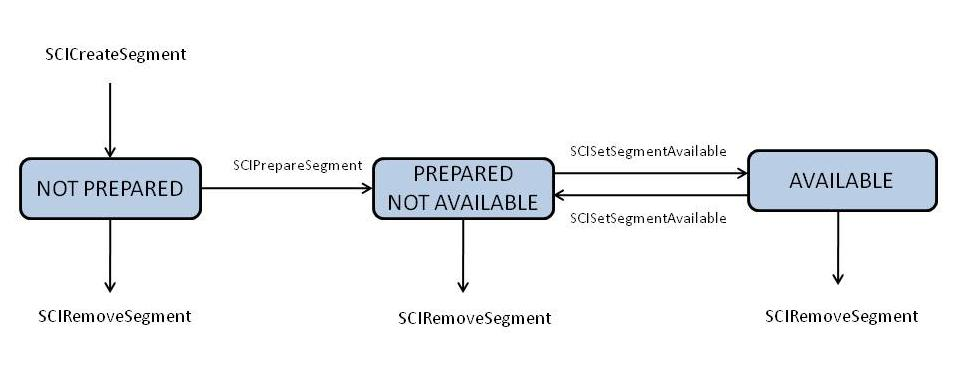
The state of a remote segment, shown in figure below, depends on what happens on the network or on the node where the segment physically resides. The transitions sci_segment_cb_reason_t are marked with callback reasons between the remote segment states.
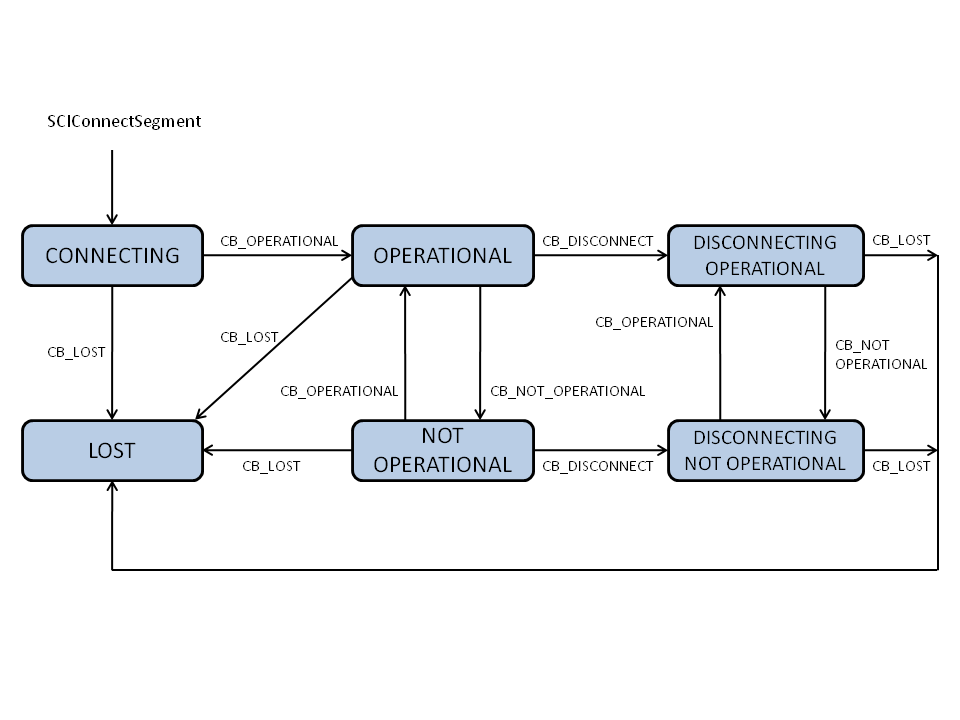
The transitions are marked with callback reasons. SCIDisconnectSegment can be called from each state to exit the state diagram.
Direct Memory Access (DMA)
PIO (Programmed IO) has the lowest overhead and lowest latency accessing remote memory. The drawback of the PIO data transfers is that the CPU is busy reading or writing data from or to remote memory. An alternative is to use a DMA engine if this is available. The application specifies a queue of data transfers and passes it to the DMA engine. Then the CPU is free either to wait for the completion of the transfer or to do something else. In the latter case it is possible to specify a callback function that is invoked when the transfer has finished. DMA has high start up cost compared to using PIO and is normally only recommended for larger transfers.
DMA is an optional feature implemented with some PCIe chipsets only. Some systems also have a “System DMA” engine. The SISCI API DMA functionality are available on all platforms supporting PCIe DMA or System DMA that is integrated and supported with the SISCI driver stack. SISCI DMA transfer functions will fail if there is no supported DMA engine available.
Interrupts
Triggering an interrupt on a remote node should be considered a fast way to notify an application running remotely that something has happened. An interrupt is identified by a unique number and this is practically the only information an application gets when it is interrupted, either synchronously or asynchronously. The SISCI API contains two types if interrupt, with and without data.
Interrupts with no data:
Interrupts with data:Device to Device transfers
The SISCI API supports setting up general IO devices to communicate directly, device to device - peer to peer communication. The alternative model, using the main memory as the intermediate buffer has significant overhead. The devices communicating can be placed in the same host or in different hosts interconnected by the shared memory fabric.
Peer to peer functionality is an optional PCI Express feature, please ensure your computer supports peer to peer transfers (Ask you system vendor).
Please consult the rpcia.c example program found in the software distribution for more information on how to set up Device to Device transfers or access remote physical memory devices.Reflective Memory / Multicast
The SISCI API supports setting up Reflective Memory / Multicast transfers.
The Dolphin PCI Express IX, MX and PX product families supports multicast operations as defined by the PCI Express Base Specification 2.1. Dolphin has integrated support for this functionality into the SISCI API specification to make it easily available to application programmers. The multicast functionality is also available with some OEM hardware configurations. (Please check with you hardware vendor if multicast is available for your configuration). SISCI functions will typically return an error if the multicast functionality is not available.
There are no special functions to to set up the Reflective Memory, programmers just need to use the flag SCI_FLAG_BROADCAST when SCICreateSegment() and SCIConnectSegment() is called.
For reflective memory operations, the NodeId parameter to SCIConnectSegment() should be set to DIS_BROADCAST_NODEID_GROUP_ALL
PCI Express based multicast uses the server main memory or a PCI Express device memory (e.g. a FPGA, GPU buffer) as the multicast memory.
PCI Express multicast transfers can be generated by the CPU, a DMA controller or any type of PCIe device that can generate PCIe TLPs.
Please consult the reflective memory white papers available at https://www.dolphinics.com/support/whitepapers.html and example programs found in the software distribution for more information on how to use the reflective memory functionality.
Support Functions
The SISCI API provide support / helper functions that may be useful.
SmartIO
NOTE: The SmartIO SISCI API extension is currently not finalized and may change in future releases without warning!
The SmartIO functionality was introduced with eXpressWare 5.5.0 and is currently only available with Linux, but may be ported to other operating systems in the future.
SmartIO is currently supported with all Dolphins PXH and MXH NTB enabled PCIe cards and licensed to selected OEM solutions based on Broadcom or Microsemi PCIe chipsets.
Please contact Dolphin if you interested in the SmartIO functionality.
The SISCI API SmartIO extension exposes features from the SmartIO module, if present. These functions are appropriate to use in order to gain low level access to devices. They can be used to write user space drivers using SISCI. The functions will work on devices anywhere in the cluster and multiple nodes can access the same device at the same time. In general, the SmartIO API will reuse ‘normal’ SISCI features where possible. For instance, device BAR registers are exposed as segments. The main SmartIO module must be configured in order for this API to function.
SmartIO devices are represented in SISCI as sci_device_t handles. This handle is initialized by borrowing the device, and released when the device is returned.
Once a device has been borrowed, it’s BARs can be accessed through a remote segment. To connect to these segments, the following function must be used. After connecting the segment is to be treated as any other remote segment. The device may also perform DMA to both local and remote segments. This must be set up by functions that map the given segment and provide the caller with the address to be used by the device to reach the given segment. Device interrupts can be attached to interrupts with associated handlers. SmartIO helper functions that may be helpfulSpecial Functions
Some special functions exists, these are available for all platforms and operating systems, but may only be needed for special environments or purposes.
The following function can be used to synchronize the CPU memory cache on systems without coherent IO (Nvidia Jetson Tegra TK1,TX1,TX2).